
Factory maintenance refers to all planned or corrective interventions aimed at keeping industrial equipment operational. In 2026, the main challenge is no longer knowing when to intervene, but how to intervene without interrupting production lines. Unplanned downtime costs an average of over 100,000 euros per hour at industrial sites, according to the ABB 2023 reliability report.
Modulating production load during interventions
There is an abundance of content on predictive maintenance, but one angle remains underexplored: the operational management of online interventions. Anticipating a failure with a sensor is not enough if the intervention itself requires a complete shutdown.
Reducing production speed rather than stopping a line is a concrete lever. On a food processing line or a continuous chemical process, lowering the flow rate by 30 to 50% during a maintenance window allows for the replacement of a critical component without emptying tanks or restarting a heating cycle.
This approach requires close coordination between the maintenance service and production management. The control system must allow for intermediate load levels, which is not the case in all installations.
All-or-nothing programmed controllers do not provide this flexibility. Before discussing artificial intelligence, ensuring that the basic automation accepts modulation remains a prerequisite that several field managers underestimate, as detailed by the Airbuzz site for the industry in its analysis of operational constraints.

Sensor data and alert thresholds: calibrate before automating
Installing IoT sensors on a fleet of equipment yields no results if the alert thresholds are poorly defined. A vibration sensor on an electric motor generates a continuous stream of data. Without a reference for normal behavior specific to each machine, alerts become noise.
Calibrating alert thresholds requires several weeks of real-world data. During this learning phase, the system records normal operating ranges: bearing temperature, vibration amplitude, current consumption. Any attempt to shorten this step results in false positives that overwhelm field teams.
What data really allows in 2026
AI-based analysis solutions identify gradual drifts that are invisible to the naked eye. A bearing that deteriorates over three months generates a characteristic vibration signature well before failure. The gain lies not in predicting an exact failure date, but in the early detection of an abnormal trend.
The most mature systems combine several data streams (vibration, temperature, current) to reduce false positives. This multi-parameter approach is documented, but its deployment remains uneven in France: the 2024-2025 surveys from CMMS providers show that at least half of the sites still operate largely in reactive mode.
Machine regulation in Europe: what changes for maintenance
The European regulation on machines (EU) 2023/1230 replaces the Machinery Directive 2006/42/EC. Its application, scheduled for January 2027, introduces requirements for the cybersecurity of control systems and for the technical documentation of equipment incorporating digital components.
For maintenance managers, this means that any connected control system must meet documented digital security criteria from the design stage. Existing machines that are substantially modified also fall within this scope.
- Industrial controllers connected to the factory network must include a cyber risk assessment, including during software updates related to predictive maintenance.
- The technical documentation must include instructions related to software components, which directly impacts version management on CMMS platforms.
- Machines incorporating machine learning functions are subject to specific requirements regarding the traceability of automated decisions.
Preparing for this transition as early as 2026 avoids the need for an urgent complete audit of the fleet in early 2027. Companies already using SaaS solutions for their maintenance have an advantage: the documentation compliance can be centralized.
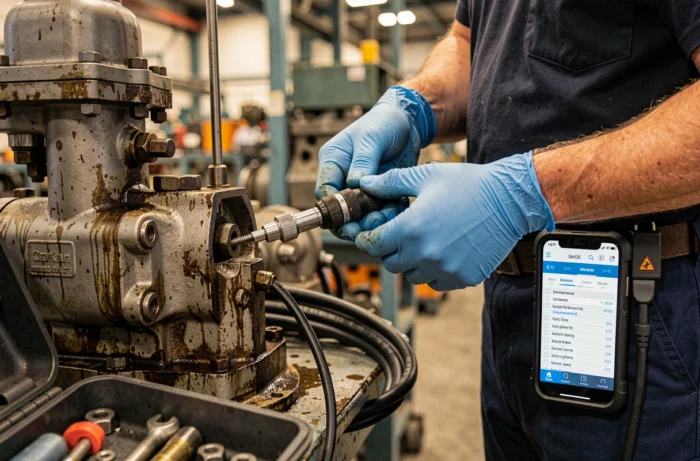
Field skills and process management: the limiting factor
Predictive maintenance technologies do not replace the skills of technicians. They shift the need: fewer emergency interventions, but more complex diagnostics. A technician receiving a vibration alert must know how to interpret the frequency spectrum to distinguish a bearing fault from an alignment issue.
The shortage of qualified profiles in industrial maintenance remains a major barrier in France. Sector surveys in 2025 confirm the difficulty in recruiting technicians who master both processes, automation, and data analysis.
Training on the actual fleet rather than on generic cases
The most effective training programs start with the equipment in place. An operator trained on the data from their own machines quickly acquires the ability to distinguish a relevant signal from an artifact. Classroom sessions on theoretical cases yield less result than on-site mentoring with access to failure histories.
- Linking each alert to documented feedback in the CMMS accelerates skill development.
- Organizing monthly reviews of avoided interventions (anticipated failures) motivates teams and validates the relevance of alert thresholds.
- Identifying a data referent for each workshop facilitates the adoption of digital tools without overloading the central IT department.
The performance of a maintenance program without production stoppage depends as much on the reliability of the sensors as on the ability of field teams to utilize the information gathered. A site equipped with state-of-the-art sensors but whose alerts go unaddressed loses the essential expected benefit. Technological investment only yields results if the decision-making process between the alert and the intervention is structured, documented, and supported by technicians trained on their own equipment.