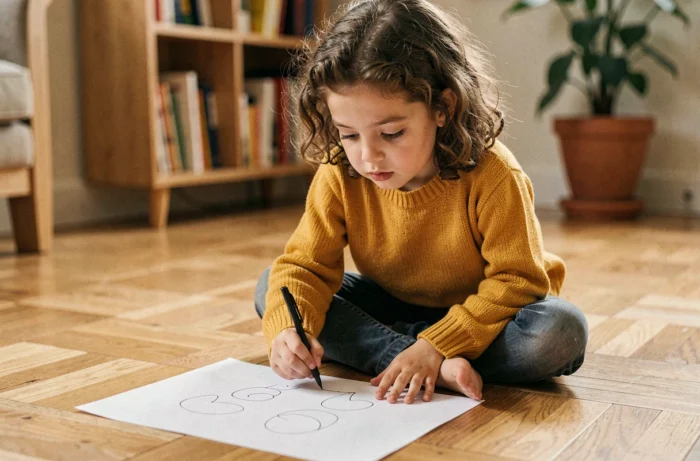
A rainy Sunday, a kitchen table, a blank sheet of paper, and a pen. Nothing more. Games with paper and pen keep children engaged without any screens and directly stimulate their creativity. Where a video game guides every action, paper allows the child to decide everything: the rules, the drawing, the pace.
What paper activates in a child’s brain
Have you ever noticed that a child drawing a maze on a blank sheet is more focused than when in front of a tablet? It’s not a coincidence. Handwriting deeply engages memory and attention.
In Italy, the new “National Guidelines” published in September 2026 place paper, pen, and cursive writing at the center of education starting from preschool. Minister Giuseppe Valditara justifies this choice by the need to “reevaluate human intelligence in the age of artificial intelligence.” France follows a similar logic: updated program support booklets in 2025-2026 introduce artistic and creative writing projects in primary and middle schools.
When a child invents a game on paper, they are not just having fun. They structure thoughts, choose words, draw shapes. Each stroke of the pen is a micro-decision that strengthens their brain connections. Free exploration on a sheet develops both fine motor skills and imagination, without any expensive materials.
To delve deeper into the link between these simple activities and cognitive development, you can discover Le Chaudron Des Jeux which details these mechanisms.
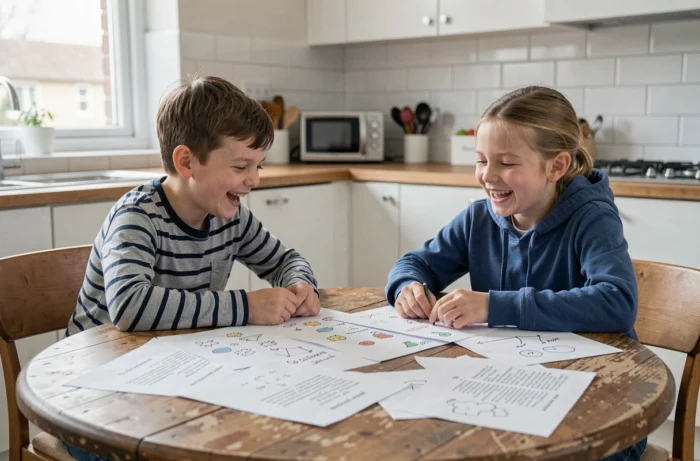
Three paper and pen games that develop different skills
Not all paper games are created equal. Some stimulate vocabulary, others spatial logic, and still others free expression. Here are three activities that cover complementary areas.
The exquisite corpse: unleashing collective imagination
Each player writes a word or a piece of a sentence, folds the sheet to hide what they wrote, and then passes it to the next player. The result is an absurd and often funny sentence. This game works as soon as the child can write a few words.
The absurdity of the exquisite corpse removes the fear of doing it wrong. The child understands that writing doesn’t have to be “correct” to be fun. They gain confidence and spontaneity. With younger children, words can be replaced by drawings: a head, a body, legs, with each drawing their part without seeing the rest.
Battleship: thinking in space on a grid
Two grids of numbered squares, boats to place, shots to announce by coordinates. Battleship requires players to navigate a two-dimensional space, memorize played shots, and anticipate the opponent’s position.
This is not a game of pure chance. A player who reasons by elimination wins more often. The child learns to formulate a hypothesis (“the boat is horizontal”), test it, and then adjust. This reasoning through trial and error prepares logical thinking well before formal mathematics.
The robot portrait with instructions: drawing under constraints
One player describes an imaginary character, the other draws following the oral instructions. “He has three eyes, a pointy hat, square hands.” This game simultaneously works on listening, understanding instructions, and graphic interpretation.
Constraints are a driver of creativity. When the child cannot draw freely, they must solve a visual problem: how to represent “square hands”? This tension between the instruction and execution produces unique results, often more inventive than a free drawing.
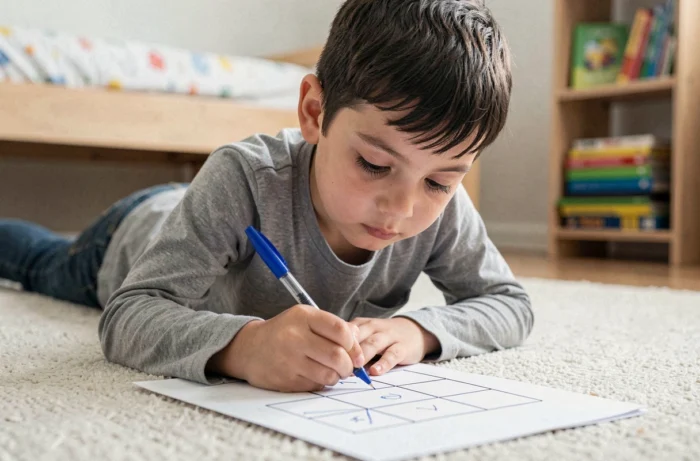
Adapting paper games according to the child’s age
The same game does not work the same way at four years old as it does at ten. A common mistake is to propose an activity that is too complex, which generates frustration instead of enjoyment.
- Between 3 and 5 years, focus on graphic games without writing: guided scribbling, drawing to complete, invented coloring. The child develops fine motor skills and associates color, shape, and emotion.
- Between 6 and 8 years, hangman, tic-tac-toe, and exquisite corpse drawing are suitable. The child reads and writes a few words, and can follow simple rules with one or two players.
- From 9 years old, Battleship, the small bac, or the robot portrait with instructions become accessible. The child manages more elaborate rules, formulates strategies, and accepts competition.
The idea is not to compartmentalize, but to start from the child’s actual level. A six-year-old child passionate about drawing can enjoy the robot portrait. A ten-year-old child who is shy about writing may prefer graphic games.
Paper games without screens: why the simplicity of materials matters
A sheet of paper and a pen is a material available everywhere: waiting room, train, restaurant, schoolyard. This accessibility changes the game.
When the materials are minimal, the child invests all their energy in invention. They do not choose an avatar or a difficulty level from a menu. They create the game themselves. A child who creates their own rules on paper does design work that pre-made games do not allow.
Recent research on digital art in education emphasizes the need to maintain a balance between digital and manual activities. Paper is not a medium “behind” technology. It is a space of freedom where mistakes can be crossed out and drafts are part of the game.
No need to organize an elaborate workshop. A sheet folded in four, a working pen, an adult or another child ready to play. Creativity arises from this simplicity, not despite it.