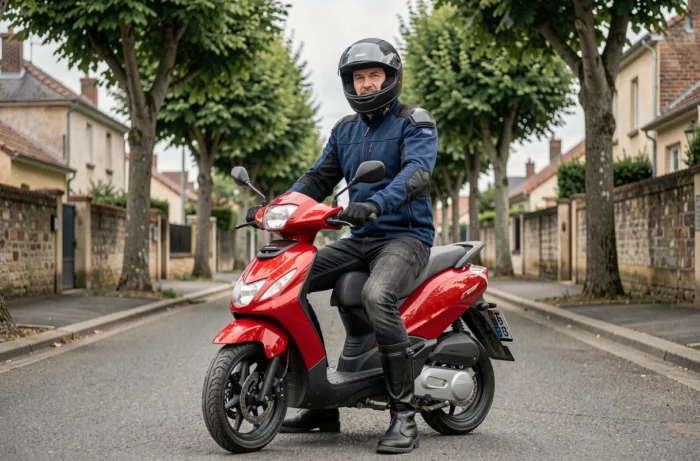
In France, the B license allows the driving of certain motorcycles and scooters of 125 cm3, provided that specific criteria of seniority and training are met. This possibility is based on a regulatory framework distinct from the classic motorcycle license (A1 or A2), with obligations that motorists sometimes underestimate.
Category of light motorcycles: what the mention 125 cm3 covers
The mention “125 cm3” actually refers to the category of light motorcycles. Their engine capacity does not exceed 125 cm3 and their power is capped at 11 kW.
The B license does not automatically grant access to category A1. It opens a conditional right, limited to French territory, which is not always recognized in other European countries. This distinction has concrete consequences for cross-border commuters or travelers: riding a 125 cm3 with a French B license in Italy or Spain can pose problems depending on local regulations.
To fully understand the associated conditions, a detailed article allows you to ride a 125 with a B license on Auto l’Hebdo by reviewing each legal requirement.
Three-wheeled scooters over 15 kW (like the Piaggio MP3 400) follow a different rule: you must be at least 21 years old and have held the B license for more than two years, but the 7-hour training remains mandatory in this case as well.
7-hour training for 125 motorcycles: program and funding limits
The mandatory 7-hour training is divided into three modules delivered in a single day at an accredited establishment. The program covers theory, off-road practice, and on-road driving.
- 2 hours of theory: awareness of specific two-wheeler risks, reading dangerous situations, personal protective equipment.
- 2 hours of off-road practice: handling the vehicle at low speed, braking, safety trajectories.
- 3 hours of on-road driving: merging into traffic, positioning on the roadway, anticipating automotive behaviors.
This training does not include any exam. A certificate of attendance is issued at the end of the day, a document to be kept at all times while driving.
Funding: the CPF does not cover the 7-hour training
Since May 2024, the CPF (Personal Training Account) only funds a first driving license, which de facto excludes holders of the B license wishing to obtain a motorcycle license. The 7-hour training, which is not a license but a regulatory training, is not eligible for the CPF.
Further tightening in February 2026 further restricts access to the CPF for motorcycle licenses, reserving it for job seekers registered with France Travail or employees benefiting from employer co-financing. The cost of this training remains entirely the responsibility of the driver.
Exemption from 125 cm3 training: specific cases
Not all holders of the B license are required to undergo this training. The exemption applies in a well-defined case: having insured and ridden a 125 cm3 two-wheeler between 2006 and 2010. Drivers who meet this condition can provide a statement of information from their insurer as proof.
Outside of this historical window, no exemption exists. A motorist who has held the B license for thirty years but has never ridden a 125 must undergo the training like everyone else.
Holders of an A1, A2, or A license obtained through the traditional route (off-road and on-road exam) are of course exempt, as they already hold a full motorcycle category.
Accident rates for 125 cm3: a real risk despite small engine size
Small engine size does not equate to low risk. In 2024, the National Interministerial Observatory for Road Safety (ONISR) recorded 81 deaths of light motorcycle users, compared to 495 for heavy motorcycles. Relative to the share of traffic from 125s, this figure remains concerning.
The profile of 125 drivers with a B license differs from that of motorcyclists trained with an A license: fewer hours of two-wheeler driving, reflexes sometimes mirrored from car driving, often incomplete protective equipment. These factors contribute to an underestimated exposure to risk.
- The high-visibility vest must be accessible (not necessarily worn at all times).
- Jacket, boots, and reinforced pants remain legally optional, but significantly reduce the severity of injuries in case of a fall.
The 7-hour training addresses these topics in theory, but a single day cannot replace the experience accumulated through a complete motorcycle course. The difference is especially evident in managing emergency braking and evasions, two skills that require regular training.
For motorists considering riding daily on a 125 cm3 and not just occasionally, obtaining an A1 or A2 license remains an option to seriously consider, even if the 7-hour training is sufficient from a legal standpoint. The difference between regulatory compliance and real preparation for two-wheeled driving deserves to be weighed before hitting the road.