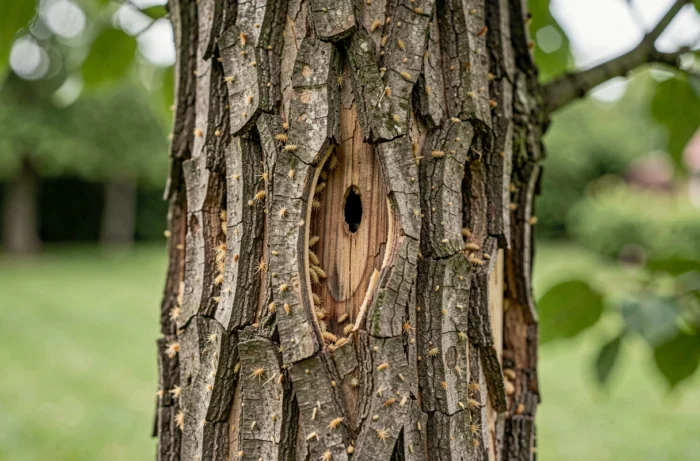
A plane tree mulberry that loses a main branch in the middle of summer, for no apparent reason, with fine sawdust at the foot of the trunk: we know this scenario in the south of France. The culprit is often the tiger longhorn beetle, a wood-boring beetle whose larvae burrow galleries in living wood. Protecting a plane tree mulberry from this insect requires understanding what is happening beneath the bark and acting at the right time.
Galleries beneath the bark of the plane tree mulberry: spotting an attack before breakage
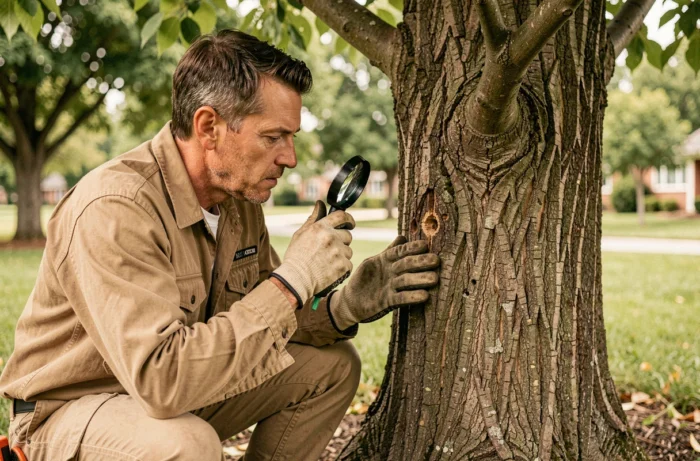
The first visible sign is not the adult insect. Oval exit holes are first spotted on the trunk or the main branches, accompanied by compacted sawdust. These orifices measure a few millimeters and can easily go unnoticed if the bark is not regularly checked.
The localized drying of a branch, while the rest of the crown appears healthy, is another warning signal. The larvae of xylotrechus chinensis (the tiger longhorn) develop inside the wood for several months, weakening the internal structure long before the tree shows aerial symptoms.
To learn more about xylotrechus stebbingi, a related pest that also targets mulberries, it is noted that the damage is comparable but the geographical distribution differs. Both insects share a larval cycle in the wood, making early detection even more crucial.
A simple test: strike the suspicious branches with a wooden mallet. A hollow sound betrays the presence of internal galleries. On a healthy tree, the resonance is full and dull.
Chopping infested wood: the rule of fragments less than 50 mm
When the tree is too affected, felling becomes the only option. The question is not so much about cutting as it is about managing the wood after cutting. An infested trunk left in a pile in a garden or transported to another municipality can spread the larvae to a new territory.
The operational guideline is clear: the wood must be shredded on-site into fragments less than 50 mm in all three dimensions. This threshold ensures the destruction of larval galleries and prevents any emergence of adults. The shredded material can then be directed to the waste disposal site with a compliant shredding certificate, allowing for safe composting.
When to fell a plane tree mulberry affected by the longhorn
The recommended period for felling and pruning is between November and April, outside the adult flight period. Intervening in summer, when the insects are active, increases the risk of spreading. A safety emergency (a branch threatening a public road, for example) justifies an intervention outside the schedule, but always in coordination with the FREDON of your region.
Feedback varies on this point depending on the departments: some municipalities organize collective felling campaigns, while others leave individuals to manage alone. Checking with your town hall remains a useful reflex.
Municipality classified as infected by xylotrechus chinensis: what it changes for individuals
A regulatory nuance often goes under the radar. When a municipality is officially categorized as “infected” by the tiger longhorn, it is no longer necessary to report each affected tree individually. The collective status triggers management measures at the municipal level.
In unclassified areas, the situation is different: every suspicious observation must be reported, ideally to the DRAAF or the local FREDON. Reporting helps update the mapping of outbreaks and adapt control measures.
- In a classified infected municipality: no individual reporting required, but the obligations for shredding wood remain strict and apply to each owner.
- In an unclassified municipality: any tree showing exit holes or suspicious drying must be reported to the local FREDON or DRAAF.
- In both cases: transporting unshredded wood off-site is to be avoided, as it is the main vector for spreading between municipalities.
Prevention on plane tree mulberry: active monitoring and planting choices
Currently, there is no approved insecticide treatment against the tiger longhorn in urban areas. Prevention therefore relies on regular visual monitoring and prompt management of affected trees.
Seasonal inspection of the trunk and main branches
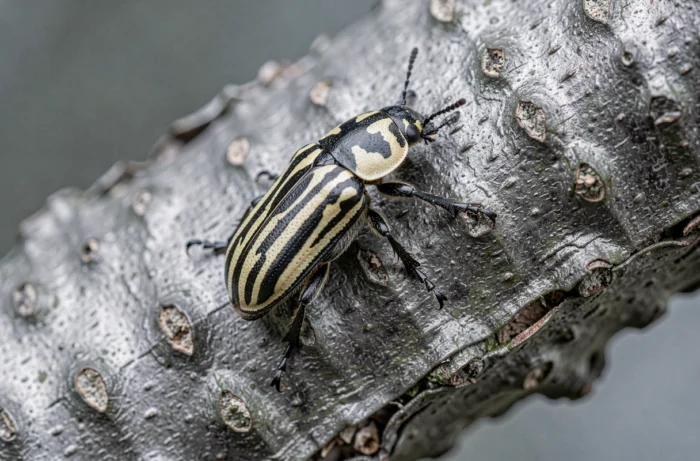
From May to September, the adults of xylotrechus chinensis are active. This is the period when the insects can be observed on the trunk, often early in the morning. Their yellow and black striped appearance makes them recognizable, but their modest size (around two centimeters) keeps them discreet.
The inspection should focus on the base of the trunk and the branch forks. Look for piles of sawdust, oval holes, areas where the bark is unusually peeling. A tree inspected twice a year has a better chance of being saved than a tree discovered infested after a branch has fallen.
Should we still plant plane tree mulberries?
The question arises in regions where the tiger longhorn is well established. The plane tree mulberry remains valued for its dense shade and drought resistance, but its vulnerability to xylotrechus chinensis makes it a risky choice in areas of active outbreak.
Diversifying species in a garden or urban alignment limits the domino effect: if all the trees on a street are mulberries, an infestation can condemn them all in a few seasons. Alternating with non-host species reduces overall pest pressure.
- Monitor existing trees rather than felling them preventively, as long as no signs of infestation appear.
- For new plantings in at-risk areas, prioritize varied species rather than a monospecific alignment of plane tree mulberries.
- Maintain healthy plane tree mulberries in areas not yet affected, while keeping a close watch on the trunk and main branches.
The tiger longhorn cannot be fought with a miracle product. Protecting a plane tree mulberry involves regular observation, strict adherence to shredding protocols, and coordination with local organizations like the FREDON. Each properly monitored tree is one less source of propagation.