
A dog wagging its tail does not always express joy. This overly quick reading of an isolated signal remains one of the most common errors in animal communication applied to dogs. Understanding canine language requires going beyond decoding signal by signal to observe a set of postures, vocalizations, and simultaneous contexts.
Wagging tail and tense body: the dog’s contradictory signals
Most guides on canine behavior offer a lexicon: ears back means fear, high tail means confidence. This simplification is excessive. A dog can have a rapidly wagging tail while keeping a stiff body and a tight jaw. Concluding joy in this case would be a misinterpretation.
The most reliable approach relies on a bundle of clues read together and in context. The same signal changes meaning depending on the overall posture, the environment, and the emotional state at the moment. For example, a yawn during a training session does not indicate fatigue but often a moderate level of stress.
To deepen this cross-reading of canine signals, a useful resource: https://canisessence.com/, which addresses the human-dog relationship from a behavioral perspective.
Dog calming signals: beyond the simple code to decode
Averting the gaze, licking the nose, shaking off after an interaction, slowing down: these gestures are often grouped under the label “calming signals.” Their function goes beyond simple binary decoding.
These behaviors regulate social and emotional tension, both in the dog itself and in its interaction with a human or another dog. A dog that turns its head away from another dog is not just saying “I am not a threat.” It is actively reducing pressure to avoid escalation.

The table below compares the simplified reading and the contextual reading of some common signals.
| Observed signal | Common simplified reading | Contextual reading (bundle of clues) |
|---|---|---|
| Wagging tail | The dog is happy | Depends on the height, speed, and tension of the body. A high and fast tail with a stiff body may indicate excitement or alertness |
| Yawning | The dog is tired | In an interaction context, often a sign of mild stress or an attempt at emotional regulation |
| Nose licking | The dog is hungry | Out of food context, a calming signal in response to a situation perceived as uncomfortable |
| Averting gaze | The dog is submissive | Active strategy of social de-escalation, not a posture of passive submission |
| Shaking off (out of water) | The dog is relaxing | Marker of transition after a tense episode. Indicates a need for recovery |
The right column shows that each signal takes its meaning within a postural and situational set. Reading an isolated behavior is like interpreting a word without knowing the sentence.
Indicators of dog recovery: spotting real well-being
Animal communication is not only used to identify problems. It also allows us to check that the dog is truly well, beyond the appearance of good humor.
Concrete markers of well-being go beyond simply observing a wagging tail. They include indicators of physical and emotional recovery that can be observed daily:
- A relaxed and supple body at rest, with no visible stiffness in the limbs or jaw
- A peaceful sleep, without frequent awakenings or repeated whimpering during rest phases
- A stable and regular appetite, without sudden refusals or compulsive eating
- A spontaneous desire to play or interact, which returns naturally after a stressful episode
A dog that recovers well after a stressful situation shows a solid emotional balance. In contrast, a dog that takes several hours to regain a relaxed behavior after a trivial event (like a bike passing by or meeting a stranger) signals an emotional fragility that deserves attention.
Daily observation versus one-time reading
A common mistake is to assess a dog’s well-being based on a single moment. An overly excited dog upon the arrival of a guest may seem happy, but if this excitement takes an hour to subside, it is more indicative of anxiety than enthusiasm.
Tracking recovery indicators over several days provides a much more reliable picture than any instant decoding grid. Observing the duration of the return to calm after a walk, the quality of sleep over a week, and the regularity of appetite: these longitudinal data build a real understanding of the animal’s emotional language.
Daily practice: training your eye rather than seeking a translator
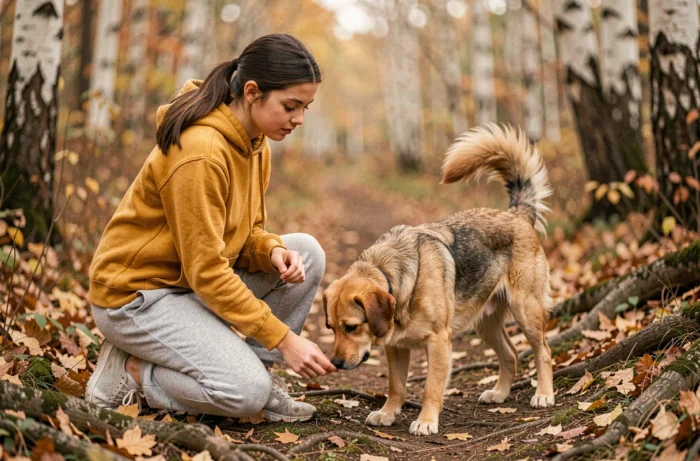
No app or miracle method can replace attentive and repeated observation. Animal communication with a dog is built over time, through attention to subtle variations in posture, breathing rhythm, and social behavior.
Three concrete habits improve the reading of canine language:
- Filming your dog during a social interaction (at the park, meeting another dog) and reviewing the sequence in slow motion to spot missed signals in real time
- Noting each day, even briefly, the dog’s general state (appetite, sleep, duration of return to calm) to detect trends over several weeks
- Observing the dog in varied contexts rather than drawing conclusions from a single environment, as the same animal can produce very different signals depending on the location and present stimuli
This regular observation practice strengthens the bond between human and dog much more effectively than a memorized theoretical grid. The relationship thrives on this shared attention, not on a vocabulary learned by heart.
The language of dogs is neither a secret code nor a binary system. It is a shifting set of postures, rhythms, and contexts that requires time and consistency. The best translation is the one we refine day by day, accepting that some signals will remain ambiguous and that this ambiguity is part of the relationship.