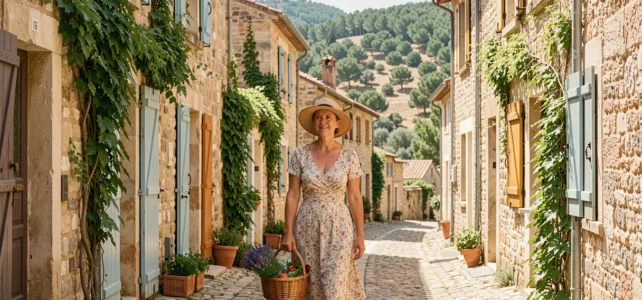
Robion is best discovered on foot, through its cobbled streets that gently climb towards the remnants of medieval ramparts. This village in the Luberon, nestled between agricultural plains and limestone hills, retains a Provençal character that neighboring more touristy towns have sometimes lost. Visiting Robion means embracing a slow pace, dictated by the dry stone and the shade of the plane trees.
Cobbled Streets and Old Houses: What the Architecture of Robion Tells Us
In Robion, the facades have not been uniformly renovated. The built heritage retains a patina that reveals its true age. The houses in the old village are constructed from local stone, with often rough lintels and shutters painted in faded tones.
The Notre-Dame-de-la-Nativité church, dated from the 12th century, serves as the central landmark. Its sober Romanesque architecture, without excessive ornamentation, reflects the spirit of an agricultural village that has never sought to compete with the neighboring papal cities.
A little further away, the chapel of the White Penitents testifies to the brotherhood life that animated these villages during the Ancien Régime. This small building, often closed, deserves a glance for its modest proportions and stripped-down facade. Several practical pieces of information about opening hours and community life are regularly updated on robion.fr, which helps in planning a visit without unpleasant surprises.
The monumental fountain, located in the village square, serves as a rallying point. It reminds us of the importance of water in these municipalities where summer drought has always shaped daily life.
Robion in the Luberon Regional Natural Park: Between Nature and Climate Constraints
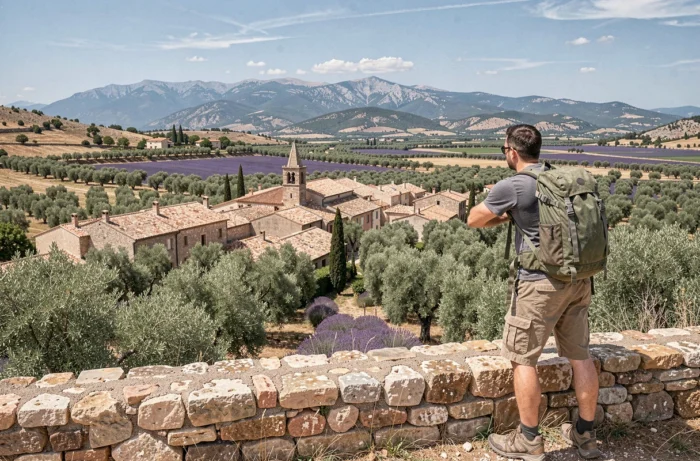
The village is located in the heart of the Luberon Regional Natural Park, which strictly regulates urban planning and protects the surrounding landscapes. The hills overlooking Robion provide direct access to marked hiking trails without the need to take the car.
Why does this natural setting deserve special mention? Because it changes with the seasons, much more radically than the lavender photos suggest.
The Reality of Summer in Vaucluse
Since the summer of 2026, the Vaucluse prefecture has placed several basins in the department, including the Durance, the Calavon upstream, and the South Luberon, under drought alert. The restrictions concern the watering of gardens, vegetable patches, sports fields, and green spaces during the day.
For visitors, this means more ochre than green landscapes in July-August, low rivers, and an atmosphere that strays from the humid postcard image of spring. The Carpentras canal, which runs alongside the municipality, remains a pleasant walking area, but don’t expect a torrent.
Spring and Autumn: The Best Seasons
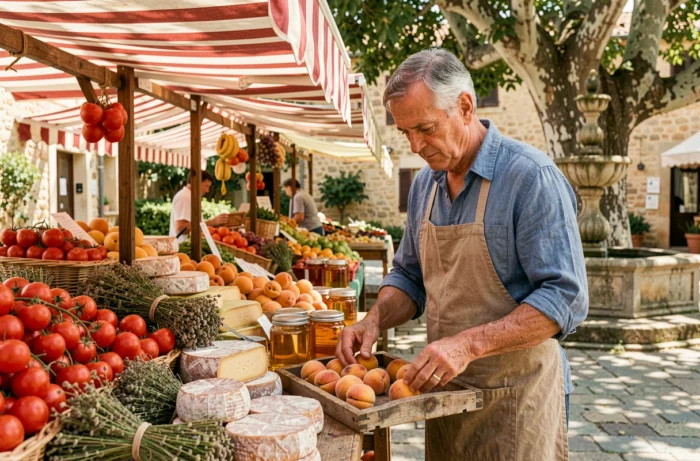
The ideal time to visit Robion is from March to June and from September to November. The temperatures are mild, the vegetation is active, and the Luberon trails are passable without suffering from the heat. Avoiding July-August also allows for a calmer experience at the Thursday morning Provençal market.
Cycling and Hiking Routes from Robion
Robion serves as a discreet yet well-located starting point for exploring the Luberon without passing through the saturated villages. Two types of routes stand out.
- The Calavon bike route, accessible from the village, follows the old railway line converted into a greenway. The path is flat, shaded in places, suitable for families and electric bikes. It connects several municipalities in the Luberon without using the departmental road.
- The hiking trails start directly from the heights of Robion towards the ridges of the Grand Luberon. The difficulty remains moderate, with gradual elevation changes. Allow half a day for a complete loop.
- The path along the Carpentras canal offers a short walk (less than an hour), with no elevation change, ideal for late in the day or with young children.
An electric bike radically changes the experience on the Calavon bike route, especially if you plan to push on to the nearby perched villages where the climbs are steep.
Sustainable Tourism in the Luberon: What It Means for Robion
Destination Luberon, the tourism office covering the Luberon Cœur de Provence area (including Robion), has been communicating since 2025-2026 about a strategy of sustainable tourism centered on residents. The stated goal is to respect the identity of the territory rather than maximize visitor numbers.
In practice, this translates into promoting short supply chains, local producers present at the Thursday market, and a desire to limit the nuisances associated with mass tourism. Robion, less known than Gordes or Ménerbes, naturally benefits from this orientation: the village has never attracted crowds, and this discretion becomes an asset.
Robion has no souvenir shops or restaurants aimed at tourist traffic. The village shops primarily serve the locals, giving the place its authentic Provençal charm.
Robion or Nearby Villages: How to Choose Your Base in the Luberon
Robion is just a few minutes from Cavaillon and half an hour from Avignon. This location makes it a practical base for exploring without enduring the prices or crowds of classified villages.
- Compared to Gordes or Ménerbes, Robion offers cheaper accommodations and a lived-in village atmosphere, not a museum-like one.
- Compared to Cavaillon, Robion retains a rural character that the market town has lost as it has expanded.
- Compared to Fontaine-de-Vaucluse, Robion avoids the tourist bottleneck while remaining close to the same trails.
The compromise between accessibility and authenticity makes Robion a relevant choice for those wanting to experience the Luberon Provence without a filter. The Thursday market, the trails of the Grand Luberon, and the tranquility of the Carpentras canal are enough to fill a stay of several days.