
Seniors looking to forge new social connections are increasingly turning to online communities. Far from being limited to traditional dating sites, these digital spaces encompass forums, thematic groups, and dedicated platforms where exchanges sometimes lead to lasting relationships. This phenomenon occurs in a context where the loneliness of older adults remains a structural issue, documented by several recent surveys.
Online Communities for Seniors: From Forum to In-Person Meeting
Most articles on the subject present dating sites as the primary tool. However, online communities operate according to a different logic. An active group on a community platform does not aim to “match” two compatible profiles; it gathers members around a shared interest, whether it be reading, hiking, cooking, or traveling.
This operation changes the dynamic. Users do not present themselves as candidates for a relationship but as participants in a discussion or activity. The meeting, when it occurs, stems from an extended exchange rather than a compatibility algorithm.
Groups aimed at those over 50 are now organizing dinners, cultural outings, hikes, and even local speed-dating events. The online community becomes a bridge to offline meetings, not a substitute. This approach can be seen on spaces like le-club-des-seniors.com, which focuses on connecting members with shared interests.
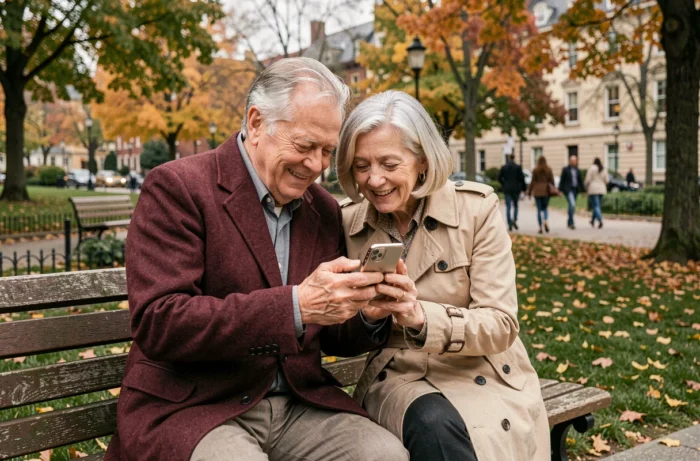
Loneliness of Seniors: A Structural Need That Digital Solutions Alone Cannot Solve
In the United States, an analysis from the National Poll on Healthy Aging at the University of Michigan (2024) reminds us that a significant portion of older adults still report feeling lonely. This observation does not only concern those isolated geographically. Seniors surrounded by loved ones also express feelings of loneliness related to the absence of chosen connections, distinct from family relationships.
Online communities partially address this need. They allow for the creation of bonds based on affinities rather than physical proximity. A senior passionate about astronomy in a rural community can exchange daily with other members, which would be impossible in their immediate environment.
However, feedback from the field varies regarding these platforms’ ability to sustainably reduce feelings of isolation. Online exchanges maintain a connection, but several research studies suggest that the transition to physical meetings remains crucial for transforming a digital contact into a meaningful relationship.
Moderation and Safety on Senior Platforms: Concrete Limitations
The question of reliability consistently arises when discussing online dating for seniors. Romance scams particularly target this age group, and generalist platforms do not always provide an adequate level of moderation.
Communities dedicated to seniors stand out in this regard through several measures:
- Profile verification upon registration, sometimes manual, which reduces the number of fake accounts and automated profiles.
- Active moderation of discussions, with explicit rules on respect and courtesy, enforced by members or administrators.
- Accessible and visible reporting features, designed for users who may not always master complex interfaces.
These measures do not eliminate risk. No platform guarantees the total authenticity of its members. Seniors who register on these spaces benefit from checking a few concrete points: does the platform display a clear moderation policy, does it offer a responsive support service, and do profiles include verifiable elements like a recent photo or a personalized description.
Digital Usage Among Seniors: Beyond Traditional Social Networks
The adoption of digital technology by those over 50 is no longer limited to checking emails or using Facebook. Recent data (2026) indicate a notable increase in the use of generative artificial intelligence in this age group, including for social and emotional purposes.
This evolution has direct consequences for online communities for seniors. Members arrive with higher expectations regarding features: searching for profiles by interest, suggestions for local activities, intuitive messaging. Platforms that do not adapt to these expectations quickly lose their active users.
The gap between highly connected seniors and those still discovering digital tools also creates a divide within the communities themselves. Some members actively participate in discussions, organize events, and post regularly. Others remain on the sidelines, reading without intervening, and sometimes end up leaving due to a lack of support.

What Distinguishes Active Communities from Abandoned Spaces
A forum for seniors with three messages per month does not facilitate any meetings. Communities that function share a few observable characteristics:
- A regular posting rhythm, with discussion topics refreshed each week by moderators or engaged members.
- An articulation between online exchanges and physical events, even modest ones (a monthly coffee in a city, a seasonal outing).
- A careful onboarding process for new members, with a personalized welcome message or sponsorship by an existing member.
The quality of a community is measured by its activity rate, not by its number of registered users. A space with a few hundred active members produces more meetings than a platform boasting tens of thousands of dormant profiles.
Online communities for seniors occupy a space that neither traditional dating sites nor generalist social networks cover adequately. Their effectiveness depends less on technology than on human engagement and the ability to transform a digital exchange into a real connection.
The available data do not yet allow for precise quantification of their impact on the loneliness of older adults. However, the trend towards organizing physical meetings from online groups constitutes a signal that this hybrid model meets a genuine demand.