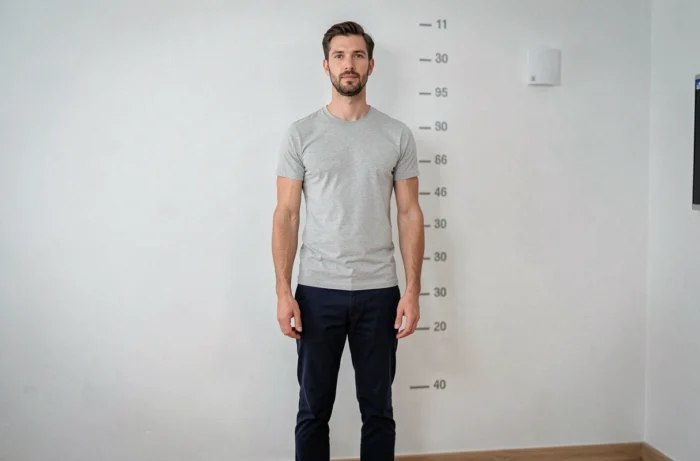
The average height of men in France has been subject to regular measurements for several decades. The most recent data confirms a long-term upward trend, but the pace of this progression is slowing significantly for generations born after the 1990s. The available figures paint a more nuanced picture than the simple observation of a population that is “still growing”.
Secular growth plateau: why young French men are almost no longer growing
The secular growth of stature, meaning that each generation surpasses the previous one in height, was consistent in France during the second half of the 20th century. Men born in the 1950s were noticeably shorter than those born in the 1980s, who themselves were surpassed by the cohorts of the 1990s.
Auxological studies on Western Europe show that this progression has stalled since the cohorts born in the early 2000s. The increase, once clear each decade, has become marginal, or even nonexistent for the youngest measured generations.
Several factors explain this plateau. The improvement in nutritional and health conditions, the main historical driver of height increase, has reached a threshold in high-income countries. Genetics sets a biological ceiling that the environment can no longer push back once basic needs are met. At the same time, the rise in overweight among children and adolescents may hinder the appropriate expression of growth potential.
To delve deeper into the average height of men in France 2025, recent data from the IFTH and public health surveys allow for a cross-analysis of stature, weight, and morphology on a representative sample.

National measurement campaign IFTH: data that goes beyond simple averages
The last major measurement campaign by the IFTH (French Institute of Textile and Clothing) dates back to 2006. The results had served as a reference for nearly two decades to calibrate clothing size charts.
A more recent campaign has updated this data with more precise scanning tools. The main objective is not to calculate a national average, but to produce grading scales usable by the textile industry.
The results include specific data by age group and gender, allowing manufacturers to target specific demographics rather than an abstract “average Frenchman”.
This observation is central: the average height is not enough to describe the actual morphology of a population. The dispersion around this average, waist circumference, bust/leg ratio, and posture are just as important for the industry as the raw height figure.
Regional and social disparities in male height in France
Public health surveys and INSEE data show that the average male height varies by region.
The social dimension is equally striking. French epidemiological studies document a link between socioeconomic status and adult stature. Men from privileged backgrounds are on average taller, a gap that persists even though its magnitude has decreased over the decades.

Weight, an inseparable variable from height
Talking about average height without mentioning weight gives an incomplete picture. French people have gained more weight than height since the 2006 campaign. The increase in overweight and obesity, documented by Santé publique France, alters the average silhouette much more than the few millimeters gained in height.
The average male BMI has increased, and waist circumference has widened. For health professionals as well as the textile industry, these parameters have become more relevant than height alone for assessing the morphological state of the population.
Limitations of available data on stature in France
Data on average height relies on different samples and methodologies depending on the sources. Self-reported surveys (where individuals indicate their own height) systematically overestimate stature by a few centimeters compared to direct measurements.
3D scanning measurement campaigns remain rare and costly, limiting their frequency. Between two campaigns, estimates rely on projections or health surveys where height measurement is not the main objective.
International comparisons pose a similar problem. Comparing the average French height to that of other European countries assumes harmonized measurement protocols, which is rarely the case. Rankings circulating online sometimes mix measured data with self-reported data, cohorts of different ages, or distant reference years.
The complete exploitation of the results from recent campaigns should provide a more reliable foundation for the coming years. The average male stature in France has remained stable for about a decade, indicating that the biological ceiling is likely reached for current living conditions.