
The international vaccination certificate for yellow fever is valid for life since 2016, when the WHO removed the requirement for a ten-year booster. This rule, integrated into the International Health Regulations, should simplify the formalities for travelers.
In reality, the situation is more nuanced: between countries that apply the standard strictly and those that maintain more restrictive practices, the yellow card remains a document to prepare carefully before any departure to an endemic area.
Border control and layovers: the real friction point in 2025
Most articles on the subject stop at the “lifetime” validity of the vaccine. The concrete problem faced by travelers lies elsewhere: at the time of arrival control, and sometimes during a simple layover.
The CDC reminds us that a country may require proof of vaccination against yellow fever for travelers arriving from or transiting through a risk country. A traveler without proof may be denied entry, quarantined, or vaccinated on-site according to local regulations. This is not a theoretical scenario.
Tanzania applies requirements described by the French Ministry of Foreign Affairs as “ambiguous,” with sometimes indistinct checks at the airport. A traveler coming from Ethiopia with a layover in Dar es Salaam may find themselves in a difficult administrative situation, even with a valid yellow card.
To fully understand the subtleties related to the yellow card and validity of the yellow fever vaccine, one must reason not destination by destination, but itinerary by itinerary, including layovers.

Yellow fever vaccine valid for life: exceptions that persist
The rule of lifetime validity applies in general cases. Several situations justify a booster or revaccination, and these exceptions are rarely detailed by mainstream sources.
- Individuals vaccinated before the age of two are considered less well protected in the long term. A booster is recommended before a new stay in an endemic area.
- Women vaccinated during pregnancy may require an additional dose, as the immune response may be potentially reduced in this context.
- Immunocompromised individuals at the time of primary vaccination (bone marrow transplant, immunosuppressive treatment) should discuss revaccination with a specialized doctor.
- Travelers going to areas of intense active circulation may be recommended a booster after ten years, depending on the advice of the consulted international vaccination center.
Lifelong validity does not mean guaranteed universal protection. It reflects a regulatory position of the WHO, based on solid epidemiological data for the general population. Special cases remain to be evaluated individually.
The ten-day delay before departure
The vaccination certificate only becomes valid ten days after the injection. This delay corresponds to the time needed to develop sufficient immunity. A traveler vaccinated six days before their flight may legally be denied entry into a country requiring the certificate.
The ten-day rule remains a distinct operational issue from lifetime validity. It requires planning vaccination at least two weeks before departure, ideally earlier to manage any potential side effects.
International vaccination card: a document undergoing modernization
The yellow card, officially “International Certificate of Vaccination or Prophylaxis,” is the only document recognized by the International Health Regulations to certify vaccination against yellow fever. No mobile application, no QR code currently replaces it in this specific context.
Côte d’Ivoire launched a new, more secure international vaccination card in April 2026, compliant with international standards. This initiative is part of a modernization related to the International Health Regulations and could foreshadow similar developments in other West African countries.
The paper card remains the global standard for crossing borders. In case of loss, the replacement procedure varies by country and can take time. Keeping a digitized copy facilitates the process but does not constitute legal proof.
Vaccination obligation in France: the specific case of Guyana
In mainland France, the yellow fever vaccine is not mandatory. The situation is different in Guyana, where vaccination is mandatory for any resident or tourist over one year old, in accordance with article R3115-63 of the public health code.
This obligation is explained by the presence of the Aedes aegypti mosquito in Guyana and the circulation of the amaril virus in the region. The vaccine used is Stamaril, a live attenuated vaccine administered in a single dose at an accredited international vaccination center.
Contraindications and exemption certificate
As Stamaril is a live attenuated vaccine, it is contraindicated in pregnant women, immunocompromised individuals, and infants under six months. For children between six and nine months, vaccination is only considered in cases of high risk of exposure.
In cases of proven medical contraindication, an exemption certificate can be issued by a doctor. This document allows entry into Guyana, but does not protect against the disease itself. Individual protective measures against mosquito bites then become the only barrier.
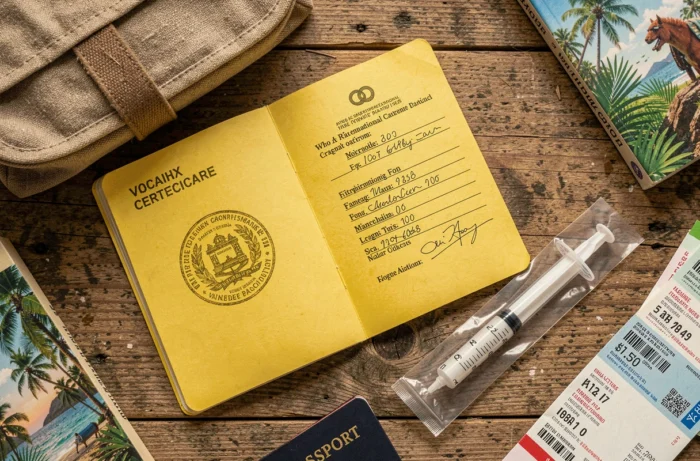
The gap between the international standard and its concrete application at borders remains the main trap for travelers in 2025. Checking the specific requirements of each country crossed (including in transit), keeping the yellow card in good condition, and anticipating the ten-day post-vaccination delay: these three points significantly reduce the risk of unpleasant surprises at boarding or arrival.