
A teacher in France typically delivers several hundred hours of classes per year, in addition to preparation, evaluation, and a growing number of administrative tasks. The challenges faced by teachers in modern education extend beyond pedagogy: they relate to the very structure of the profession, its working conditions, and the rapid transformation of student demographics.
Teacher Shortage and Work Overload in Schools
The first Global Report on Teachers by UNESCO, published in 2024, projects a deficit of 44 million teachers by 2030 worldwide, with 15 million in sub-Saharan Africa alone. This shortage does not spare high-income countries, where declining attractiveness of the profession and retention difficulties exacerbate the situation.
When positions remain vacant, the teachers in place absorb the workload. Classes fill up, overtime accumulates, and the time available to prepare a lesson or provide individual support to a student decreases. This mechanism creates a cycle: the more the profession deteriorates, the less it attracts, and the less it attracts, the more it deteriorates for those who remain.
To explore this issue from a complementary angle, one can read on Mon Blog Beauté an analysis of the daily difficulties faced by teachers.
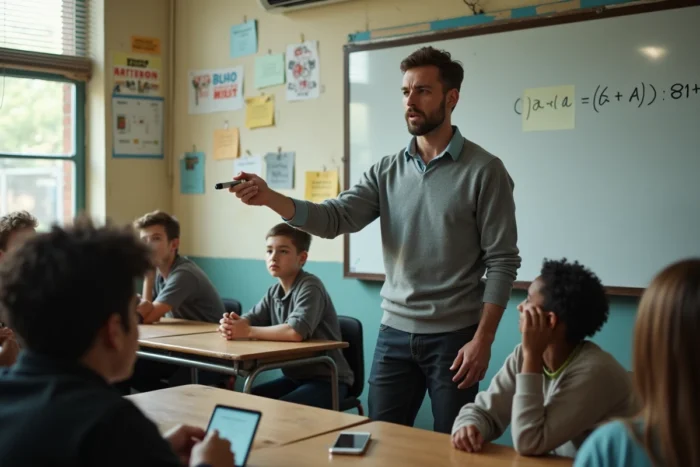
Classroom Discipline: A Documented Obstacle for Teachers
Managing student behavior is a distinct challenge from administrative workload, yet the two feed into each other. According to a comparative European report based on the TALIS 2024 survey, about 45% of OECD teachers consider maintaining discipline a source of stress. Among novice teachers, this proportion rises to 55%.
This figure reflects a gap between initial training and the reality on the ground. Teacher preparation programs devote little time to concrete classroom management strategies. The result: teachers who master their academic discipline but find themselves powerless in the face of a restless group or repeated disruptive behaviors.
Why Novices Are More Exposed
An experienced teacher has developed routines, non-verbal signals, and authority built over time. A novice must build everything simultaneously: their credibility, their lessons, and their classroom management. This triple demand explains why the first years of teaching concentrate the highest dropout rate from the profession.
Mentoring programs, when they exist, mitigate this shock. However, their deployment remains uneven across academies and institutions.
Inclusive Schooling and Transformation of Pedagogical Practices
For about twenty years, the inclusive school policy has profoundly changed the daily lives of teachers in France. The analysis by Frédéric Dupré, a lecturer in education sciences at Insei and CY Cergy Paris University, points to a phase of “reconfiguration” that began in 2019, marked by significant tensions.
School inclusion is not limited to welcoming students with disabilities into a regular class. It requires a much more complex network of work than simply managing heterogeneity: coordination with aides for students with disabilities, communication with families, adaptation of materials, and drafting of follow-up documents.
What Inclusion Concretely Changes in Teaching Work
- Pedagogical differentiation requires preparing multiple levels of content for the same lesson, which multiplies preparation time
- Coordination meetings with medical-social professionals add to the schedule without systematic hourly compensation
- Assessment must take specific needs into account, complicating grading and tracking progress
These transformations do not always come with sufficient training. Many teachers discover adaptation mechanisms in situ, without a theoretical foundation or structured feedback.

Integration of Digital Tools in Teaching: Between Promise and Reality
The use of digital tools in schools has accelerated, particularly after the period of remote teaching. The promise is well-known: personalized learning, expanded access to resources, more detailed tracking of students. The reality in schools is more mixed.
Material equipment varies significantly from one institution to another. Some schools have individual tablets and reliable connections; others operate with aging computers and insufficient bandwidth. This inequality in infrastructure creates a concrete barrier even before discussing digital pedagogy.
Teachers’ Digital Competence: An Ongoing Challenge
Mastering a tool does not mean knowing how to integrate it into an effective pedagogical sequence. The digital competence of teachers covers a broad spectrum:
- Knowing how to select a reliable resource from thousands available online
- Adapting a digital exercise to the actual level of students, not just the theoretical level of the curriculum
- Managing distractions related to screens in class without banning the tool itself
- Protecting students’ data within a constantly evolving regulatory framework
Ongoing training on these topics remains fragmented. Teachers who progress often do so through self-training or informal exchanges among peers, without a coherent institutional pathway.
Recognition of the Teaching Profession and Attractiveness of the Profession
The material obstacles (salaries, working conditions, resources) and pedagogical challenges (inclusion, digital tools, discipline) converge towards a fundamental question: the place accorded to the teaching profession in society. The decline in the number of candidates for recruitment competitions in France reflects an attractiveness problem that goes beyond mere remuneration.
A teacher who simultaneously manages overcrowded classes, students with very diverse needs, poorly integrated digital tools, and a growing administrative burden ultimately has to arbitrate between what is feasible and what would be desirable. This constant arbitration between pedagogical ideals and real constraints defines, more than any other factor, the daily life of the profession today.
Responses to these challenges will not come from a single lever. Initial and ongoing training, material working conditions, and institutional recognition form a whole. As long as one of these pillars remains fragile, the others compensate poorly.