
On a medium-sized pool with a sand filter, the pump is turned on at the beginning of May and turned off at the end of September. Between the two, it runs several hours a day, sometimes more when the heat rises. The filtration system represents the largest portion of the electricity bill related to the pool, far ahead of lighting or the cleaning robot. Understanding the energy consumption of a sand pump starts with knowing where the kilowatt-hours go to act in the right places.
Hydraulic sizing and actual consumption of the sand pump
Most guides limit themselves to the classic formula: power in kW multiplied by the number of operating hours. This gives a theoretical figure, but it can deviate significantly from reality. The hydraulic circuit plays a crucial role in actual consumption.
A pipe with too narrow a diameter between the skimmer and the sand filter increases pressure in the circuit. The pump has to work harder to maintain the filtration flow, and excessive pressure degrades the energy efficiency of the whole system. The same phenomenon occurs with an oversized pump relative to the pool volume: it pumps too much, creates unnecessary pressure losses, and consumes more than a properly sized pump.
Before trying to optimize filtration hours, it’s beneficial to check three concrete points on the installation:
- The diameter of the pipes between the pool, the pump, and the sand filter (an undersized diameter creates a permanent resistance that the pump must compensate for).
- The consistency between the pump’s nominal flow rate and the actual volume of the pool, taking into account the distance and bends in the circuit.
- The condition of the seals, valves, and fittings, as an air leak on the suction side forces the pump to work harder to maintain priming.
As shown in the detailed analysis on Habiz, the sizing of the circuit is often a neglected lever while it directly conditions the kWh consumed each season.
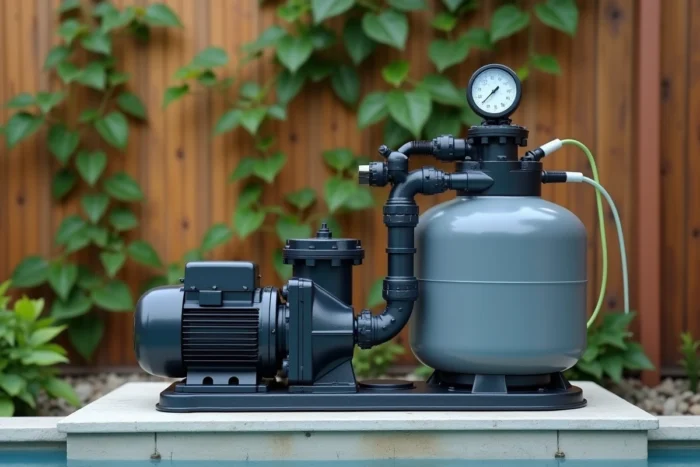
Variable speed or fixed pump: the consumption gap over a season
It is often said that switching to a variable speed pump reduces the bill. This is true, but the savings depend on the usage profile. In a pool equipped with a sand filter, the filtration must circulate the entire volume of water in a given time. With a fixed-speed pump, it runs at full power for the necessary duration and then stops.
A variable speed pump operates differently. It runs at a reduced speed over a longer time frame, sometimes for most of the day. The power consumed drops significantly at low speed. Reducing the speed by half can divide the electricity consumption by a factor much greater than two, as the relationship between speed and absorbed power is not linear.
In practice, over a complete filtration season, returns vary depending on the size of the pool and the local climate, but switching from a conventional pump to a variable speed pump remains the technological change that produces the most significant reduction in consumption. It is a higher initial investment, amortized over a few seasons by the reduction in electricity costs.
When fixed speed remains relevant
For small above-ground pools with a compact sand filter, the supplied pump typically runs at modest power. The consumption gap with a variable model would be small, and the additional cost at purchase is not always justified. The gain from a variable pump is proportional to the starting power: the more powerful the initial pump, the more the switch to variable speed makes a measurable difference.
Backwashing the sand filter: an ignored consumption item
The sand filter retains impurities over the filtration cycles. The sand gradually clogs, and the pressure in the circuit rises. When this pressure increases, the pump has to work harder to maintain the flow. A clogged filter increases the pump’s consumption before we even realize it.
Backwashing reverses the flow of water to dislodge dirt trapped in the sand. The best practice is to monitor the filter’s pressure gauge. When the pressure exceeds the threshold indicated by the manufacturer (usually displayed on the device), backwashing is triggered. Programming a backwash every week out of habit, without checking the gauge, leads either to washing too often (wasting water and energy) or not enough (overloading the pump).
During the backwash itself, the pump runs at full speed for a few minutes. This is not a major consumption item in itself, but a regularly maintained filter maintains optimal hydraulic efficiency throughout the season. The cumulative effect over several months is tangible.
Filtration scheduling and electricity rates
The daily filtration duration mainly depends on the water temperature. The warmer the water, the faster microorganisms develop, and the longer the filtration needs to be. In the height of summer, we often run well beyond what is sufficient in spring or early autumn.
Adapting the filtration duration to the season rather than leaving a fixed setting from May to September is a simple gesture that reduces overall consumption. A timer allows scheduling operating periods during off-peak hours, when the price per kWh is lower. The volume of energy consumed remains the same, but filtering during off-peak hours reduces costs without affecting water quality.
Coupling filtration and solar production
For installations equipped with photovoltaic panels for self-consumption, aligning filtration with peak sunlight hours allows for absorbing some of the excess solar production. The sand filter pump, with its regular and predictable consumption, is well-suited for this type of control. Some home automation systems automatically trigger the pump when solar production exceeds a defined threshold.

The consumption of a sand pump is not just a theoretical calculation on a label. The hydraulic circuit, the condition of the filter, the choice of pump technology, and the timing of filtration form a whole. Acting on just one of these parameters produces a limited effect. Combining them, however, can transform the filtration item from an energy sink into a controlled expense, season after season.