Fashion operates in cycles of a few months, but the signals that matter no longer come solely from runway shows. Behavioral data from visual platforms, user searches, and recent regulations are reshaping what constitutes a sustainable trend. Understanding these mechanisms allows us to filter out the noise and identify the pieces that deserve a place in a wardrobe.
Fashion trends drawn from behavioral data: what searches reveal
Traditional trend analyses rely on the runways of Paris or Milan. Another approach is to observe what people are actually searching for, in volume and growth, on visual platforms.
A Pinterest report published in August 2026 on the festival season highlights three strong signals. Searches related to summer festival outfits have seen a significant increase, indicating that looks are being prepared well in advance of the event. Tropical maximalism, a mix of saturated prints, bright colors, and oversized accessories, dominates the saved pins. At the same time, the so-called “showgirl” aesthetic (rhinestones, feathers, sequins, stage silhouettes) is exploding in associated queries.
These trends are based on real usage rather than editorial selections. This is precisely the type of content found in the fashion section of On s’appelle, which focuses on analyzing concrete inspirations rather than compiling runway looks.
Sensory fashion: textures and materials rather than silhouettes
Most trend pages focus on cuts and colors. A less documented shift concerns the physical relationship with clothing, what can be called sensory fashion.
Pinterest observes a rise in tactile hobbies (ceramics, embroidery, leatherwork) and a transfer of this sensitivity to the wardrobe. Velvet, satin, and silk are returning in searches not as symbols of luxury, but as materials chosen for their touch.
Materials to prioritize from this tactile perspective
- Corduroy is gaining ground in wide pants and structured jackets, appreciated for its texture and visual warmth.
- Lightweight satin is replacing shiny polyester in long flowing dresses, offering a more natural drape and superior comfort.
- Thick wool blend knits are taking the place of fine knits for mid-season pieces, responding to a demand for density and durability.
This tactile prism alters purchasing criteria. The question is no longer solely “what does this piece look like” but “what effect does it have to the touch.” Searches combining a material name with a type of clothing (for example, “midi satin skirt” or “corduroy straight leg jeans”) are progressing significantly faster than those focusing solely on silhouette.
Anti-fast fashion law in France: a framework that changes purchasing habits
Since September 1, 2026, the French anti-fast fashion law has come into effect. It imposes penalties on ultra-fast fashion brands, but its effects extend beyond this single segment.
The text is part of a broader European regulatory movement, particularly linked to the ESPR (Ecodesign for Sustainable Products Regulation) and the obligations of extended producer responsibility (EPR) in textiles. In France, the organization Refashion is already overseeing traceability and testing of textile products brought to market.
Concrete consequences on style and piece choices
Mid-range brands are adjusting their collections by reducing the number of references and extending the expected lifespan of each piece. For consumers, this translates into better-constructed basics, more refined finishes, and less volatile color ranges from season to season.
A useful reflex is to check the composition and weight of fabrics before purchasing, rather than relying solely on photos. A dense cotton jean with a limited percentage of elastane will last several seasons. A lined viscose dress will withstand better than a single-layer piece sold at the same price.
Building a trendy look for 2026: successful combinations
Rather than a list of pieces to buy, the logic of combinations allows one to take advantage of what already exists in a wardrobe while integrating the signals of the season.
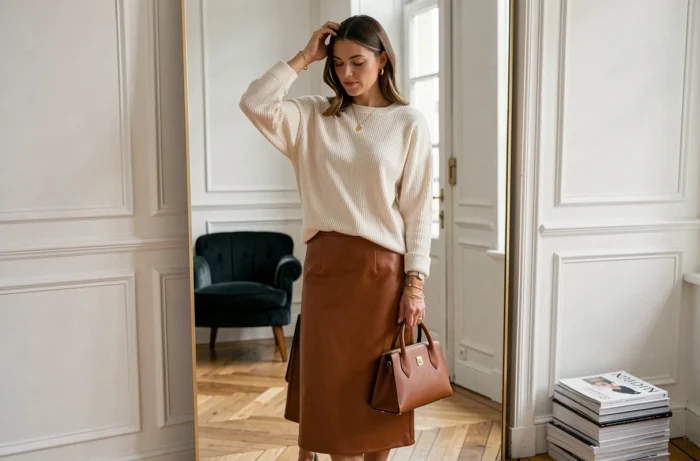
The structured wide pant remains the key piece. Worn with a thick knit top and flat shoes, it creates a chic, effortless look. The same pant paired with a satin top and bolder accessories (large earrings, textured bag) shifts to an evening register.
The long flowing dress, present in all spring-summer collections this year, can be adapted for autumn with a short velvet jacket or an oversized blazer. Warm colors (terracotta, mustard, olive green) extend its use until November without it looking out of place.
Three combination rules to remember
- Pair a piece with rich texture (velvet, knit, satin) with a neutral, matte piece to avoid sensory overload.
- Limit prints to a single element per outfit when adopting tropical maximalism, with the rest of the look serving as a visual anchor.
- Favor a single expressive accessory (brooch, scarf, statement belt) rather than accumulating several, which concentrates the stylistic impact on a focal point.
The start of the 2026 school year is characterized by a balance between visual boldness and material demands. Signals converge: platforms show that searches focus as much on the touch of a fabric as on its color, and regulations push towards more thoughtful purchases. The resulting style relies less on the accumulation of new items than on the quality of combinations between carefully chosen pieces.