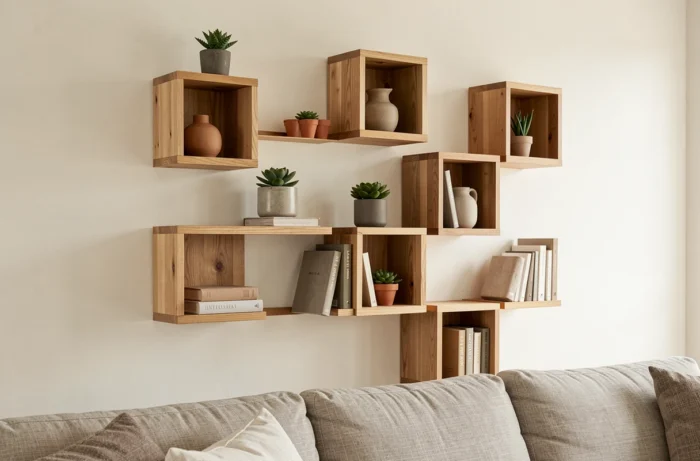
Fixing a wooden cube shelf to the wall may seem trivial. The question that deserves analysis is less about style and more about the compatibility between the type of wall, the actual load of the filled cube, and the method of attachment. It is this relationship between technical constraints and decorative outcome that determines whether a wooden cube shelf lives up to its promises over time.
Permissible load according to wall type: what NF DTU 25.41 prescribes
The choice of a wall-mounted cube shelf begins with a data point often overlooked: the load-bearing capacity of the support. NF DTU 25.41, which governs plasterboard partitions, distinguishes three load thresholds for hanging elements.
| Load per anchor point | Prescribed fixing method | Specific constraint |
|---|---|---|
| Up to 10 kg | Direct fixing (screw, nail) | No particular constraint |
| Between 10 and 30 kg | Metal expansion or toggle anchors | Minimum spacing between anchor points |
| Above 30 kg | Load transfer to the framework | Solid wood reinforcement integrated into the partition |
An empty solid wood cube already weighs several kilograms. Add books, decorative items, and the load increases quickly. Beyond 30 kg per anchor point on BA13, no anchor is considered sufficient: it is necessary to create a load transfer to the framework studs.
On a concrete block or solid brick wall, the constraint almost disappears. However, the majority of interior partitions in recent homes are made of plasterboard, making this data crucial for anyone considering a composition of several cubes.
Choosing a wooden cube shelf for decoration therefore requires checking the nature of the load-bearing wall in advance and adapting the fixing system accordingly.

Open or closed cube shelf: impact on use and aesthetics
The trend for 2025-2026 highlights wall compositions combining open cubes and closed cubes in the same installation. The idea is simple: alternate visible objects and discreet storage on the same wall surface.
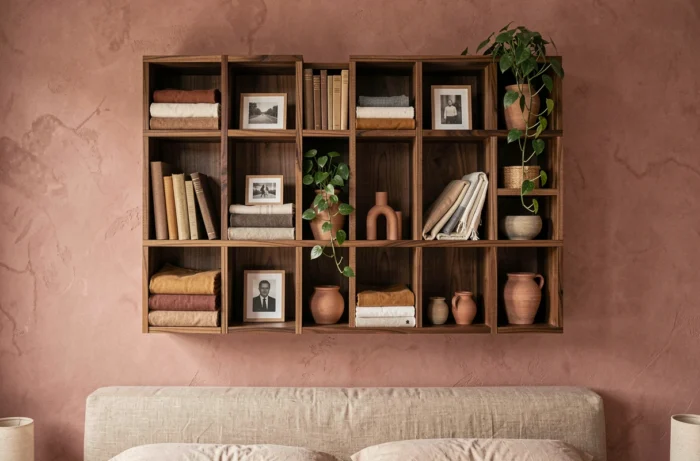
An open cube exposes its contents. It works like a frame: a plant, a vase, a book lying flat become full-fledged wall decoration elements. On the other hand, it requires a constant effort to stage. A poorly arranged open cube quickly resembles a wall pocket.
A closed cube (with a door or solid back) hides the clutter. It is suitable for entryways, hallways, and rooms where storage takes precedence over decorative effect. Its weight is also higher, which directly relates to the load question mentioned earlier.
Combinations to favor according to the room
- Living room or lounge: majority of open cubes (two-thirds), complemented by one or two closed cubes to hide remote controls, cables, or small everyday items
- Office or bedroom: balanced alternation between open and closed, to display a few items while concealing files or supplies
- Entryway or hallway: dominant closed cubes, with a single open cube for a decorative touch (keys, candle, small frame)
The mixed composition avoids the uniform showcase effect that visually fatigues and forces impeccable storage at all times.
Wood types and finishes: what really changes between two cubes
The material influences both weight, durability, and visual appearance. Three main categories coexist in the market for wall-mounted cube shelves.
Solid wood (oak, beech, walnut) offers the best mechanical resistance and aesthetic aging. It is also the heaviest, complicating attachment to lightweight partitions. European buyers are willing to pay significantly more for solid wood furniture sourced from sustainably managed forests.
MDF (medium-density fiberboard) is the most accessible option. Lightweight and easy to paint, it allows for uniform matte or lacquered finishes. Its limit: it does not handle humidity well and degrades faster under constant load. An MDF cube that bends in the middle after a few months generally carries too much weight relative to the thickness of the panel.
Plywood occupies an intermediate position. More resistant than MDF at equal thickness, lighter than solid wood, it is well-suited for standard depth cubes. Its laminated appearance on the edges divides opinions: some find it raw and contemporary, while others see it as unfinished.
Non-drilling fixation: credible alternative or fragile compromise
Non-drilling fixing systems (high-performance double-sided adhesives, industrial suction cups, glued rails) appeal to renters. Their promise: to install wall cubes without touching the wall.
For a lightweight MDF cube, empty or filled with very light objects, some adhesives do indeed hold. The limit appears as soon as the content exceeds a few kilograms. No adhesive system can replace a mechanical anchor for a cube filled with books.
Adhesive rails offer better load distribution than a simple glue dot. However, they remain sensitive to temperature, humidity, and the quality of the wall support (a wall painted with glossy or satin paint reduces adhesion).
Checklist before choosing the fixing method
- Weigh the empty cube, then estimate the maximum load once filled (books, ceramics, potted plants)
- Identify the nature of the wall: plasterboard, brick, concrete, wood
- For BA13 with a load exceeding 10 kg, plan for metal expansion anchors and check the spacing between points
- For a composition of several cubes, add the loads and ensure the wall can support the total cumulative load
Wall decoration with wooden cube shelves relies on a balance between the desired visual effect and the physical constraints of the support. The most elegant cube remains the one that stays on the wall without cracking the partition, five years after installation. Checking the load before choosing the style remains the logical sequence, even if the desire pushes to do the opposite.