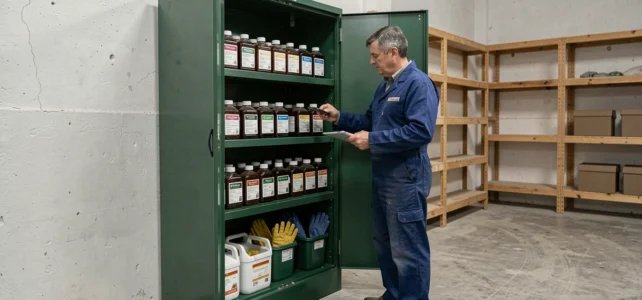
Sales of plant protection products in France rebounded in 2024, driven by an increased use of fungicides. This rise in volumes to be stored raises a practical question for farmers, garden centers, and local authorities: how to secure storage without blowing the equipment budget. The phytosanitary cabinet remains the reference device, but not all are created equal, and the displayed price does not always reflect the actual cost of use.
Retention tank and ventilation: what drives the bill up or down
The price of a phytosanitary cabinet primarily depends on two technical aspects that product sheets rarely highlight with the same clarity: the integrated retention tank and the ventilation system.
The retention tank is used to contain accidental liquid leaks. Its capacity must be proportional to the stored volume. A tank that is too small forces an investment in a second ground retention device, which negates the savings made at purchase. The cheapest models sometimes offer a removable plastic tank whose chemical resistance to solvents and concentrated formulations remains limited over time.
Ventilation can be passive (high and low grids) or active (electric extractor). A mechanically ventilated cabinet costs more, but it limits the accumulation of gases and vapors inside the unit. For flammable products or formulations that emit volatile compounds, active ventilation reduces the risk of ignition and internal corrosion.
Finding an inexpensive phytosanitary cabinet that incorporates these two elements without technical compromise requires comparing specifications beyond the catalog price. A discounted model with a galvanized steel retention tank and properly sized ventilation grids protects just as well as an oversized high-end model for actual use.
Phytosanitary cabinet and regulations: the real control points
French regulations impose specific conditions for the storage of plant protection products. Operators storing these substances must have a dedicated room or cabinet, locked, ventilated, and equipped with a retention tank. These requirements are not optional: they are checked during CAP conditionality controls and phytosanitary inspections.
The agricultural emergency law of 2025-2026 reintroduced certain molecules like acetamiprid and flupyradifurone under derogation, which were previously banned. These substances are subject to enhanced monitoring. Operators using them must be able to document their storage conditions (locked cabinet, retention, ventilation) to demonstrate their risk management in case of inspection or post-incident assessment.
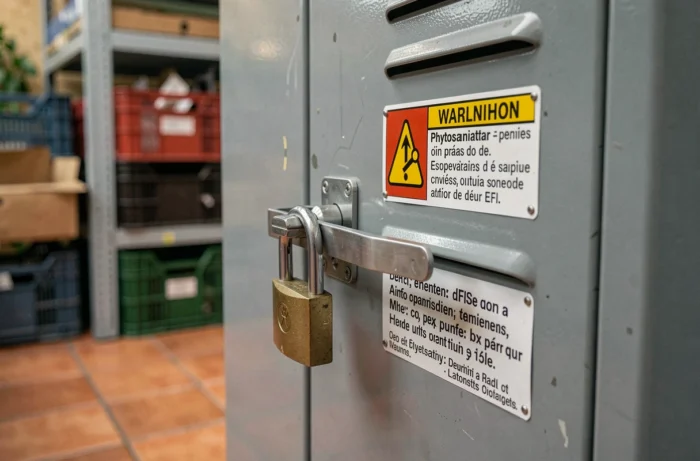
A often overlooked point: signage. The cabinet must display the hazard pictograms corresponding to the stored products. Compliant models integrate them from the outset on the doors. On a generic cabinet converted for phytosanitary storage, this signage is missing, which constitutes a non-compliance during an inspection.
What an inspector checks in practice
- The effective locking, not just the presence of a lock but its daily use, with a key held by an identified person
- The condition of the retention tank: no cracks, no residues of uncleaned products, sufficient capacity relative to the stored containers
- The physical separation between phytosanitary products and other inputs (fertilizers, seeds, veterinary products)
- The presence of shelves made of chemical-resistant material, generally steel with epoxy or galvanized coating
Flat-pack cabinet or assembled cabinet: what impact on durability
The cheapest phytosanitary cabinets are often sold flat-pack. Assembly is accessible, but the quality of the final assembly entirely depends on the user. Insufficient tightening of shelves or poor positioning of the retention tank can compromise the overall seal.
Models delivered assembled cost more, partly due to transport (higher weight and volume). However, factory welds and pre-assembled joints offer better corrosion resistance than assemblies with screws and bolts exposed to chemical splashes.
For an operation storing modest volumes (a few dozen liters), a well-assembled flat-pack cabinet that is regularly inspected serves its purpose for several years. For larger volumes or particularly corrosive products, investing in a welded model is justified over time.
Selection criteria for a budget phytosanitary cabinet
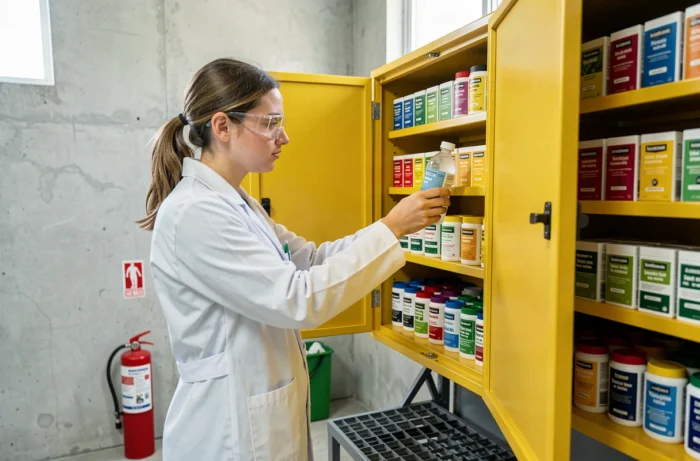
The market offers cabinets of very variable dimensions, from a narrow column with one door to a wide model with two doors. The choice depends less on the available space than on the type and number of containers to be stored.
Key trade-offs
Fire resistance is a direct safety criterion. Some cabinets boast fire resistance for several minutes, allowing time to intervene in case of a fire in the room. Entry-level models do not always offer this protection, and the price difference between a basic cabinet and one with insulating walls remains moderate.
The load capacity of the shelves deserves attention. Five or ten-liter cans are heavy. An undersized shelf deforms, and the deformation creates metal-to-metal contact areas conducive to corrosion. Checking the permissible load per level avoids unpleasant surprises.
- Prefer a model with a steel retention tank rather than plastic for solvent-based products
- Check that the ventilation (passive or active) is suitable for the type of products stored, especially flammable products and gaseous formulations
- Ensure that the doors have a locking system with a key or padlock, not just a simple latch
Secure storage of plant protection products is not a topic that tolerates approximation, but it does not require an oversized budget either. A properly specified cabinet, with retention, ventilation, and locking, protects users and the environment. Economy comes from the right sizing, not from safety components.