
Pruning requires specific tools, distinct from those used for ground work. Choosing a suitable pruner involves considering several technical parameters (guide length, motorization, weight) alongside the actual constraints of the site: height of intervention, diameter of branches, frequency of use. The market today offers thermal, corded, and battery-powered machines, each catering to a different usage profile.
Repairability and eco-design of pruners: an underestimated selection criterion
Most buying guides compare power, weight, and guide length. Few, if any, address the issue of mechanical durability and the availability of spare parts. Yet, this is a decisive factor in the actual cost of the tool.
The European regulation ESPR on eco-design, adopted in 2024, will gradually impose durability, disassembly, and recycled material content requirements on garden power tools. Battery-powered pruners are directly affected.
In practical terms, this means that the ease of battery replacement, the availability of compatible chains and guides, and the possibility of repairing the motor or casing become essential purchasing criteria. A model sold without a structured spare parts network will lose its value more quickly, including at resale. On elagueuse-warrior.com, product sheets allow you to check these elements before purchase.
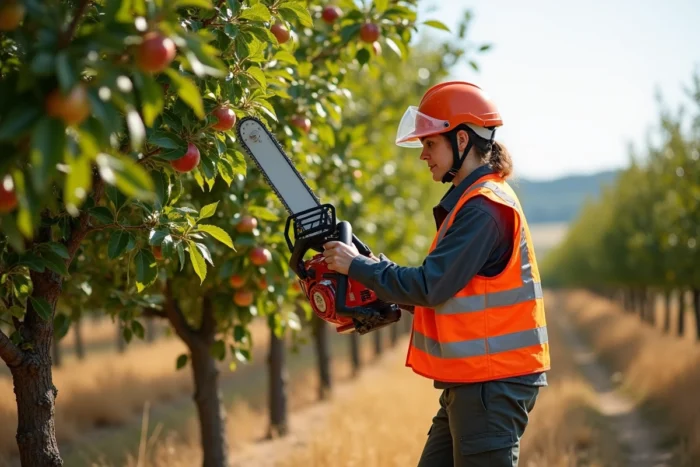
Battery, thermal, or corded pruner: what the field demands
The choice of motorization is not merely a personal preference. It depends on three concrete variables: the location of intervention, the duration of the job, and the average diameter of the branches to be cut.
Urban and regulatory constraints
Low emission zone (LEZ) policies and noise constraints in urban areas are increasingly steering professionals and local authorities towards electric or battery-powered pruners. For interventions in residential areas or city centers, thermal options pose a growing compliance issue.
On the other hand, for forestry jobs or intensive pruning over long days, thermal engines maintain a clear advantage in autonomy. Field reports vary on the exact point at which the current lithium-ion battery reaches its limits, but most professional users place this threshold around half a day of continuous cutting.
Corded: a very limited use case
The corded pruner is confined to small gardens, in immediate proximity to a power outlet. Its main advantage is the lower entry price compared to thermal or battery options. Its limitation is clear: the cord prohibits any real height work and any mobility around a large tree.
Guide bar and power: adapting the tool to branch diameter
The length of the guide bar directly determines the maximum cutting diameter. For routine maintenance (branches up to about fifteen centimeters), a short guide is sufficient and improves maneuverability. For thicker wood, a longer guide becomes necessary, but it adds weight to the tool and reduces precision in elevated positions.
Three technical parameters deserve systematic verification before purchase:
- Chain pitch: a smaller pitch offers a finer cut and puts less strain on the motor, making it suitable for precision pruning. A wider pitch cuts through wood faster but generates more vibrations.
- Weight/power ratio: when working at height, every gram counts. A pruner that is too heavy fatigues the operator and increases the risk of losing control. Models designed for canopy work rarely exceed a few kilograms.
- Anti-vibration system: during prolonged sessions, the absence of damping leads to documented musculoskeletal disorders. This criterion often separates consumer machines from professional models.
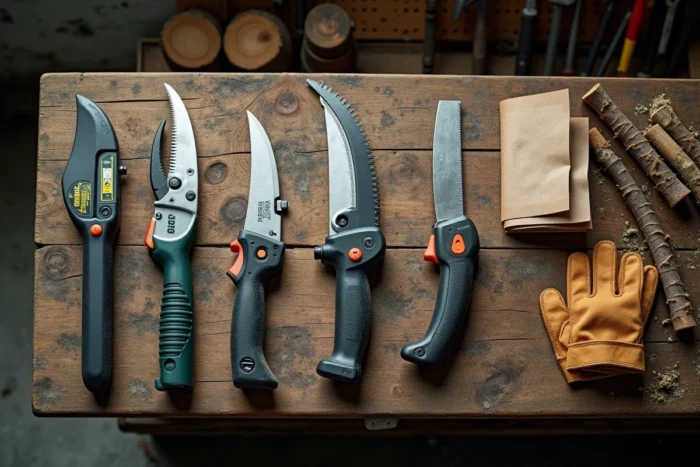
Telescopic pruner: when and why to consider it
The telescopic pruner allows you to reach high branches without climbing or using a lift. It meets a specific need: to cut branches of small to medium diameter located between three and five meters, from the ground.
This type of tool is not a substitute for a traditional pruner. It complements it. The pole extends the lever arm and reduces cutting precision, making it unsuitable for fine work or heavy branches that need to be controlled during their fall.
For an individual with a few fruit or ornamental trees, a battery-powered telescopic pruner often represents the best compromise between accessibility and safety. For a professional, it serves as a complementary tool, used before the main intervention to clear low branches.
Safety and regulation: what guides often overlook
In France, the use of a “top handle” pruner is reserved for work at height. Ground use of this type of pruner is prohibited by regulations. This distinction, rarely mentioned in consumer comparisons, nevertheless conditions the choice of model.
Beyond regulation, safety relies on verifiable elements:
- The inertia chain brake, which stops rotation in the event of kickback.
- The front hand guard, sized to cover the entire width of the handle.
- The tool-less chain tensioning system, which facilitates regular adjustments and limits risks associated with a poorly tensioned chain.
Regular maintenance of the chain (sharpening, tensioning, lubrication) significantly reduces the risk of accidents. A dull chain forces the operator to apply more pressure, which destabilizes the machine and causes kickbacks.
Choosing a pruner commits you to several seasons of use. Prioritizing a model with available parts, whose motorization matches the actual terrain, and whose safety devices comply with current standards remains the most reliable method to avoid a purchase that needs to be redone two years later.