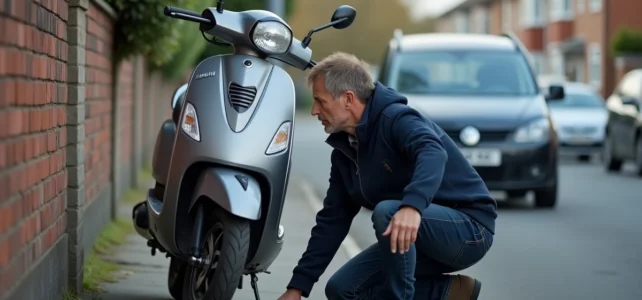
Buying a used scooter or car involves two simultaneous considerations: the acquisition price and the maintenance cost over the following two or three years. Comparing these two aspects before signing helps avoid a good deal at purchase turning into a mechanical money pit. This article measures the differences between used scooters and cars on the points that truly impact the budget, from registration to wear and tear of parts.
Recurring costs: used scooter vs used car in table
Both types of used vehicles share identical expense categories (insurance, engine maintenance, tires), but the amounts and frequency of interventions differ significantly. The table below summarizes the differences over a typical ownership cycle.
| Item | Used Scooter | Used Car |
|---|---|---|
| Registration card (certificate of registration) | Reduced regional rate, often exempt for small displacement two-wheelers | Variable based on fiscal power and region, significantly higher amount |
| Engine oil change | Short interval (every few thousand km), low unit cost | Longer interval, but higher unit cost (oil volume, filter) |
| Tires | Two wheels to replace, quick wear on wet roads | Four wheels, higher unit price, wear varies by size |
| Braking | Compact pads, frequent replacement | More expensive discs and pads, but often longer lifespan |
| Technical inspection | Mandatory for scooters and motorcycles since 2024 | Every two years after the fourth year |
Over a two-year cycle, the used scooter generally costs less in routine maintenance. However, the used car amortizes its parts better due to longer replacement intervals.
Specialized platforms like Scoot Auto aggregate listings of used scooters and cars, making it easier to directly compare prices and displayed mileages even before traveling.

Environmental penalty and registration of an imported used vehicle in 2026
Since January 1, 2026, the environmental penalty applies to imported used cars upon their first registration in France, based on their CO₂ emissions. This measure affects vehicles from the European Union as well as those imported from third countries.
Cars already registered in France remain exempt from this penalty in case of resale between individuals or through a professional. This discrepancy creates a situation where the same car costs more to register if it comes from abroad than if it is already circulating in the territory.
For scooters, the environmental penalty does not apply in the same way: motorized two-wheelers remain outside the CO₂ scale used for cars. Therefore, purchasing an imported used scooter does not incur additional costs related to emissions. This point changes the equation for buyers considering a vehicle from Germany, Belgium, or Italy.
Registration procedures for an imported vehicle
The registration change procedure goes through the ANTS website. The European conformity certificate, a technical inspection less than six months old, and the tax clearance certificate are the documents to gather. For an imported scooter, the request for a registration certificate follows the same process, but the amount of the regional tax differs.
Used battery on scooter or electric car: the benchmark to know
The purchase of a used electric scooter or electric car raises a central question: the condition of the battery. Future European standards require that an electric or plug-in hybrid vehicle battery retains at least 80% of its initial capacity at 5 years or 100,000 km, then 72% at 8 years or 160,000 km.
These thresholds provide an objective benchmark for evaluating a battery before purchase. Requesting a state of health (SOH) certificate from the seller allows checking if the battery still meets these levels. An SOH below 80% on a vehicle less than five years old indicates abnormal degradation.
The SOH certificate protects both the buyer and a good maintenance log on a thermal vehicle. On a used electric scooter, the battery represents an even larger portion of the total vehicle value, making this check all the more crucial.
Warranty and preventive maintenance: items that change depending on the type of vehicle
The legal warranty of conformity covers any used vehicle purchased from a professional. Its duration and conditions remain the same for a scooter and a car. However, dealerships and specialized garages offer warranty extensions whose scope varies depending on the type of engine.
Regarding preventive maintenance, the priorities differ:
- On a used scooter, the drive belt and variator are the wear parts most often neglected by previous owners, and their late replacement can damage the engine
- On a used thermal car, the timing (belt or chain) and the clutch kit concentrate the heaviest expenses if the maintenance log has gaps
- For both types of vehicles, checking the brake fluid, the condition of the discs, and the wear of the tires remains the minimum baseline before any handling
Price stabilization in the used market
After several years of marked increases between 2021 and 2025, used prices have recently stabilized. This calm opens a more favorable negotiation window for buyers, both for scooters and cars. Comparing listings over several weeks allows spotting vehicles whose prices drop without apparent mechanical reason, indicating that the seller is in a hurry.
The choice between a used scooter and a used car depends less on the purchase price than on the total cost over two years, including maintenance, insurance, and any registration procedures. Asking about the SOH on an electric vehicle or checking the drive belt on a thermal scooter are reflexes that weigh more on the final budget than negotiating the displayed price.