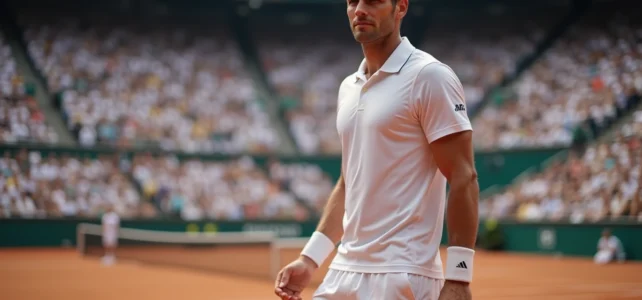
Novak Djokovic has accumulated over two decades on the ATP professional circuit. His prize money earnings surpass those of all other players in the history of tennis, both men and women. This longevity at the top has built a fortune whose structure far exceeds the checks cashed on the courts.
Revenue Redistribution in Tennis: Why Prize Money Doesn’t Tell the Whole Story
Grand Slam tournaments boast record prize pools every year. Roland-Garros, Wimbledon, the US Open, and the Australian Open compete with announcements about their total prize money. The gross figure is impressive, but it masks a structural imbalance.
Recent analyses show that players now receive only about 15% of the revenue from a tournament like Roland-Garros. The trend is downward. The organizers’ revenues are growing faster than the amounts redistributed to the athletes.
For a player of Djokovic’s caliber, this means that the relative share of prize money in his total income decreases year by year. The Serbian tennis player has publicly taken a stance on this issue of redistribution, believing that players deserve a fairer share of the pie. This economic context partly explains why knowing how much Novak Djokovic earns in 2025 requires looking well beyond sports results.

Djokovic’s Cumulative Prize Money: Absolute Record in World Tennis
The Serbian has accumulated over $153 million in tournament winnings throughout his career. This amount places him ahead of Roger Federer and Rafael Nadal, his two historical rivals, who do not reach this level.
No other player has crossed this threshold. Serena Williams, Andy Murray, and Carlos Alcaraz remain far behind in cumulative prize money. This record is based on a combination of factors:
- Exceptional longevity at the highest level since 2003, with regular Grand Slam victories over more than twenty years
- A consistent ability to reach the final stages of major tournaments, where prize money increases exponentially
- The continuous rise in prize money during the 2010s and 2020s, which Djokovic has fully benefited from due to his late-career dominance
Prize money remains the most visible source of income, but it represents only a fraction of the player’s overall fortune.
Sponsorship and Advertising Contracts: The Real Financial Engine
Like most top athletes, off-court earnings far exceed competition winnings. Advertising and partnership contracts are the main pillar of Novak Djokovic’s fortune.
The player has multiplied collaborations with brands in sports equipment, watchmaking, automotive, and nutrition. These multi-year agreements generate stable income, independent of on-field results. Unlike prize money, which fluctuates based on performance, a sponsorship contract guarantees a fixed payment with bonuses tied to media visibility.
Why Sponsors Pay More Than Tournaments
The logic is simple. A tournament redistributes a portion of its revenue among dozens of players. A sponsor, on the other hand, invests in a single athlete to capture the attention of millions of viewers worldwide.
Djokovic’s global fame extends beyond tennis. His participation in public debates (health, redistribution in sports, players’ conditions) amplifies his media presence and increases the value of his image for advertisers.
Investments and Diversification: Wealth Beyond the Court
An athlete earning tens of millions per year for twenty years has capital to grow. Djokovic has adopted a diversification strategy that goes beyond simple financial investment.
His interest in football illustrates this approach. The player has been announced as a future shareholder of Mans FC, a French football club. This type of investment in professional sports allows for transforming athletic capital into sustainable asset holdings.
- Equity stakes in clubs or companies related to sports
- Structured philanthropic projects (Novak Djokovic Foundation, educational commitments in Serbia)
- Development of a personal brand that can be leveraged after his career ends
This diversification sets Djokovic apart from players who remain dependent solely on competition and sponsorship income.

Estimated Annual Salary of Djokovic in 2025: Key Components to Know
Talking about “salary” for a tennis player is a misuse of language. A tennis player does not have a fixed salary: his annual income depends on a combination of distinct sources.
In 2025, Djokovic’s income is broken down into three main blocks. Prize money, which varies depending on the number of tournaments played and the results achieved. Sponsorship and advertising contracts, which are relatively stable from year to year. Investment income and image rights, which are growing as his portfolio diversifies.
The Effect of Age on Income Structure
Djokovic is approaching the end of his competitive career. The share of prize money in his total income tends to decrease, while passive income (investments, image rights, speaking engagements) takes over. This financial transition is planned: the accumulated fortune no longer depends on the ability to win one more match.
The record for tournament winnings, massive sponsorship contracts, and wealth diversification place Djokovic among the highest-paid athletes in history, across all sports. His fortune is built on an economic model developed over twenty years, not on a single exceptional season.