
A phone vibrating at one in the morning, a name appearing, three words on the screen. Before even reading the message, we start to interpret. Late-night texts from a girl often trigger a cascade of questions, while the context of the person writing remains completely invisible to the recipient.
Nocturnal emotional state and recipient’s perception bias
We forget a fundamental parameter: the night alters emotional regulation. A message sent at two in the morning can reflect a restless state (stress, loneliness, insomnia, anxiety) as much, if not more, than romantic interest. The literature on sleep and nocturnal emotional regulation documents this phenomenon, but online interpretation articles remain silent on it.
The other blind spot is the recipient’s filter. Two people can receive exactly the same message and evaluate it very differently depending on their own emotional state. If one is craving attention, they will read interest. If one is suspicious, they will suspect manipulation. The SMS has no objective meaning; it is the receiver who creates it.
Before deciphering late-night texts and their meaning, it would be beneficial to examine what state we are in ourselves at the moment of reception.

Late-night text from a girl: three concrete situations that change everything
Rather than seeking a universal framework, let’s start from specific scenarios. The content of the message, the frequency, and the pre-existing relationship weigh much more than the time of sending.
The brief message after a night out
A “what are you doing?” or “are you awake?” sent on a Friday past midnight, after a night out with friends. In this case, alcohol, group euphoria, or simply the boredom of the end of the night are enough to explain the sending. A late-night text is not a declaration.
If this type of message repeats every weekend, the recurrence says something. An isolated message says almost nothing.
The long conversation that spills into the night
We’ve been exchanging since 9 PM, responses are flowing, and suddenly it’s 1 AM. No one decided to write “late.” The discussion simply slipped. This scenario indicates a real commitment to the exchange, a desire to continue talking with this particular person.
This is often the most reliable sign of genuine interest, because it is based on prolonged effort rather than a three-second impulse.
The isolated message, without context, in the middle of the week
A text that arrives on a Tuesday at 2 AM, without prior exchange, with personal or emotional content. This case points more towards a need for comfort, a night of insomnia, or a moment of vulnerability. The person is seeking presence, not necessarily a relationship.
Responses vary on this point, and that’s normal: the same gesture can express attraction in one person and distress in another.
When a late-night SMS becomes a warning signal in the relationship
Online content almost exclusively treats the late-night message from the angle of seduction. We overlook a less comfortable aspect: late messages as a tool for control.
In relationships where jealousy or control are present, a text sent at a late hour can serve to:
- Test the other person’s availability (“where are you?”, “are you already asleep?”) to verify their actions
- Provoke a feeling of guilt if the recipient does not respond quickly
- Establish a habit of immediate response, regardless of the time, which normalizes a form of surveillance
This is not the most common case, but it deserves to be identified. If late-night texts generate anxiety rather than pleasure, the dynamic is problematic.
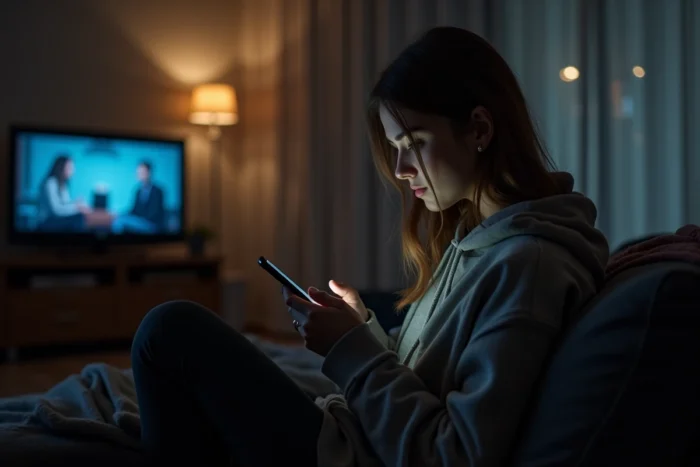
Responding to a late-night message without overanalyzing
We often spend more time dissecting a text than responding to it. A few concrete guidelines help break the interpretation loop:
- Respond when you wish, not out of obligation to be reactive. A message read at 2 AM and addressed the next morning does not send a negative signal; it simply shows that you were sleeping
- Adapt your response to the actual content of the message, not to the time of sending. A “good night” does not require the same response as a long personal text
- Observe the coherence between nighttime exchanges and daytime behavior. Someone who writes every night but remains distant during the day sends a contradictory signal
Coherence between day and night remains the best indicator. A genuinely interested person does not limit their communication to the hours when emotional barriers are at their lowest.
Ultimately, a late-night SMS is just a fragment. It neither replaces an honest conversation nor a relationship built on regular exchanges in broad daylight. The most useful reflex when receiving a message late at night: sleep on it, literally.