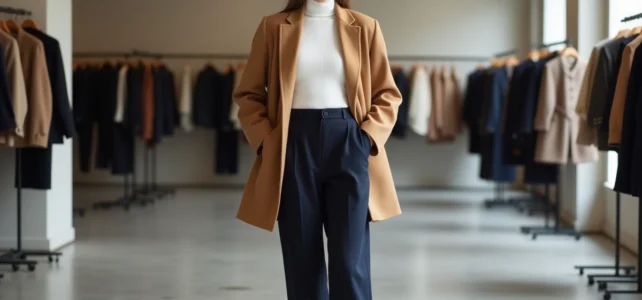
Between the anti-fast fashion law adopted in France and the rise of radical minimalism on the runways, the fashion trends of 2026 can no longer be reduced to a list of items to buy. The question arises: what objective criteria allow us to distinguish a sustainable trend from a fleeting fashion effect, and how do recent regulatory constraints reshape the style landscape?
Anti-fast fashion law and fashion trends: what French regulation changes
Competitors listing trendy pieces overlook a structuring fact. France adopted a law in 2026 targeting ultra-fast fashion, with a financial penalty of up to 20 euros per item by 2030, capped at 50% of the product’s pre-tax price.
This penalty is not symbolic. It directly targets brands whose model relies on the constant renewal of low-priced collections. Part of the penalties is directed towards collection and recycling infrastructures, pushing brands towards repair, reuse, and sustainable materials.
The law also prohibits advertising for ultra-fast fashion brands, including through influencers. Affected sites must display messages encouraging sobriety and reuse. For anyone following fashion trends via social media, this means that certain sponsored content will simply disappear from the French landscape. Influencers who violate this ban face individual financial penalties.
In practice, those who want to explore the fashion page of L’Actu Dissidente will find an analysis of these regulatory developments and their impact on daily clothing choices.
Comparison table: minimalist cuts vs. maximalist pieces
The Pinterest Predicts report and the spring-summer 2026 shows outline two opposing stylistic lines. To measure their relevance in daily life, here is a factual reading grid.
| Criterion | Minimalist line | Maximalist line |
|---|---|---|
| Dominant cuts | Structured wide trousers, long fluid dress, tone-on-tone coordinated sets | Sculptural volume skirt, textured layers, expressive accessory pieces (brooches, bold details) |
| Color palette | Neutral tones, beige, off-white, sky blue | Orange, bright pink, yellow, olive green |
| Daily versatility | High: office, outings, travel | Medium: requires context or mastery of combinations |
| Stylistic durability | Strong: these cuts last through several seasons | Variable: depends on the pattern and intensity of the trend |
| Regulatory impact (2026 law) | Low: pieces often offered by brands outside ultra-fast fashion | More exposed: highly seasonal pieces are typical of rapid renewal |
This table reveals a clear gap. Minimalist cuts withstand seasonal cycles better and are less affected by the regulatory penalty, as they do not rely on constant renewal.
Sustainable aesthetics and long-lasting garments: concrete gaps
The opposition between minimalism and maximalism is not only aesthetic. It has measurable consequences on the lifespan of a wardrobe.
A structured wide linen or thick cotton trouser can be worn for several seasons without looking dated. In contrast, an extreme volume skirt made of fine synthetic material loses its shape after a few washes and falls out of trend within months. The quality of the fabric determines longevity more than the cut itself.
Coordinated sets, very present on the runways of Milan and Paris, illustrate this logic well. A top and bottom in the same shade and material form a strong visual block that does not depend on any seasonal accessory to function. Style relies on cut and color, not on novelty.
- Favor natural materials (linen, dense cotton, wool) whose shape does not degrade after a season, rather than fine synthetic fibers that lose their structure quickly.
- Check the finishing of seams and hems: a well-assembled garment can withstand repairs, which aligns with the reuse logic encouraged by the 2026 law.
- Opt for colors that work in combination with the existing wardrobe, rather than for a spectacular shade that requires new complementary pieces.

Influence of social media on style: what Pinterest data reveals
The Pinterest Predicts report remains one of the few tools that quantifies clothing searches before they saturate social networks. For 2026, the data points to a coexistence between searches related to poetcore (flowy dresses, soft silhouettes) and a renewed interest in structured leather pieces.
Leather is returning as a statement material, not as a seasonal trend. Associated searches focus on jackets and accessories, not disposable pieces. This positioning aligns with the constraints of the anti-fast fashion law: leather (whether genuine or quality plant-based) has a cost that naturally places it outside the ultra-fast fashion spectrum.
The ban on advertising for ultra-fast fashion brands via influencers also alters the visibility of trends. The pieces promoted on French networks now come from brands compliant with the regulations, which mechanically shifts the visible aesthetic towards mid-range and higher price ranges.
Ethics and fashion 2026: the regulatory filter as a style criterion
Affirming a style without compromise in 2026 is not just about choosing between a flowy dress and wide trousers. The French regulation now acts as a selection filter that guides available choices.
Brands subject to the penalty must integrate this cost into their prices or reduce their production volume. For consumers, this means that the cheapest pieces on the market will gradually become more expensive, while brands that already focus on sustainability face no penalties.
- Brands offering repair and reuse benefit from a direct competitive advantage against the gradual penalty.
- Ethical and traceable pieces become a visible differentiation argument, as penalized brands must display sobriety messages on their own sites.
- Choosing a durable piece is no longer just a stance: it is a rational response to a changing market.
The assertive style of 2026 is built on an apparent paradox: fewer visible choices on social networks, but better-selected pieces in wardrobes. The regulatory constraint, far from limiting personal expression, pushes towards garments whose line and material speak for themselves.