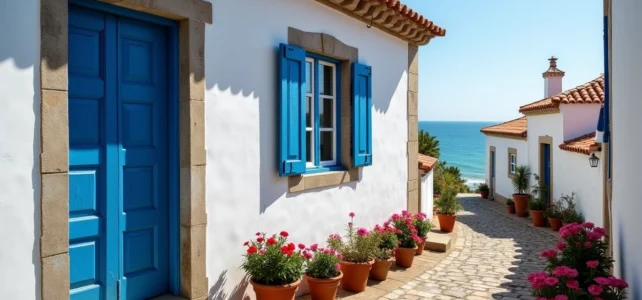
The market for fisherman houses in Portugal is now segmented into micro-zones with very different price dynamics and regulations. Investing in this type of property is not just about choosing between the Algarve and Lisbon: profitability depends on the local tax framework, the structural condition of the old buildings, and the ability to obtain a tourist accommodation license.
Structural Constraints of Fisherman Houses: Technical Diagnosis Before Acquisition
Portuguese fisherman houses present recurring pathologies related to their proximity to the sea and their traditional construction methods. Walls made of limestone or rammed earth (taipa), roofs with canal tiles without insulation, untreated wooden joinery: the technical assessment conditions the entire financial setup.
Rising damp due to capillarity remains the most frequent problem. On the coast, salinity accelerates the degradation of coatings and reinforcements. A serious renovation involves treatment by injection of hydrophobic resin, foundation repairs if necessary, and compliance with electrical standards according to the Portuguese RGIE.
We observe that buyers systematically underestimate the renovation costs. For an old property close to the sea, the rehabilitation cost can represent half of the purchase price, sometimes more when the load-bearing structure is compromised. Engaging an independent civil engineer before the promissory sale agreement (CPCV) is not optional.
- Check for the existence of an up-to-date caderneta predial and urban compliance with the câmara municipal
- Request a topographic survey to confirm the cadastral boundaries, which are often unclear on old coastal plots
- Verify the classification of the property in the PDM (Plano Director Municipal): some houses in protected areas cannot change their use
- Identify public maritime domain servitudes, which prohibit any construction in a defined coastal strip
Those looking for a fisherman house for sale in Portugal on ImmoVenture will find detailed listings outlining the condition of the building and the precise location, allowing for quick filtering of viable properties.
Alojamento Local License: What Law No. 21/2023 Changes for Investors
The regulatory tightening initiated in 2023 has changed the rules of the game for the tourist operation of fisherman houses. Law No. 21/2023 has suspended the granting of new Alojamento Local licenses in several pressured areas, notably in Lisbon and Porto.
Coastal municipalities are now applying IMI surcharges for properties operated as tourist accommodation. This property tax increase raises fixed costs and mechanically reduces the net margin, especially on the small areas typical of fisherman houses.
In practice, we recommend checking three points before any commitment:
First, consult the câmara municipal to find out if the area still allows the issuance of new AL licenses. Next, estimate the impact of the IMI surcharge on net yield. Finally, anticipate compliance obligations (fire safety, accessibility) that apply to ALs and may require additional work on old buildings.
Areas that remain open to AL are mainly located on the Silver Coast and the northern Alentejo coast. These secondary markets offer a double advantage: significantly lower entry prices and a less restrictive regulatory framework.
Price Gap Between Central Algarve and Secondary Coasts in Portugal
Central Algarve (Quinta do Lago, Vale do Lobo, Albufeira coastal) has reached a plateau where old houses close to the sea rarely sell for less than one million euros, even when they require heavy renovation. This price level makes net rental yield marginal for an investor financing through loans.
The Silver Coast and northern Alentejo remain well below these levels. Locations like Nazaré, Peniche, or the segment between Sines and Porto Covo show a gradually increasing dynamic but start from accessible bases. The ratio between acquisition price and rental potential is significantly more favorable there.
Rental Yield in Portugal: The Variables That Matter
The gross yield of rental real estate in Portugal reaches 7.3% on average according to the latest available data. This figure masks considerable disparities depending on location, property size, and mode of operation.
A small fisherman house in seasonal rental can exceed this average yield in areas with high summer demand, provided that renovation costs and AL taxation are managed. Conversely, in premium Algarve, the high entry price compresses net yield below 4%.
Location Selection: Operational Criteria for a Profitable Investment
The choice of village is not based on the charm of white and blue facades. Three technical criteria differentiate locations:
- The distance to an international airport served by low-cost airlines, which conditions the occupancy rate in seasonal rentals
- The actual availability of AL licenses in the municipality, verifiable with the Registo Nacional de Alojamento Local
- The existence of a collective sewage network, absent in some coastal hamlets, complicating compliance with health standards
The coastline between Sesimbra and Setúbal combines proximity to Lisbon, airport access, and still reasonable prices. Further south, Ferragudo and Cacela Velha offer a high-end positioning without reaching the prices of the golden Algarve.
Taxation on Resale: Capital Gains Tax in Portugal
The capital gain realized upon the resale of a property in Portugal is taxable at 50% of the gain, integrated into the income of the Portuguese tax resident. For a non-resident, the flat rate applies to the entire gain. Reinvesting the proceeds from the sale into a primary residence in Portugal allows, under certain conditions, to exempt this capital gain, a mechanism that French investors sometimes use to optimize their exit.
The market for fisherman houses in Portugal remains promising as long as each acquisition is treated as a technical and fiscal project, not as a love at first sight. The secondary coastal areas today offer the best compromise between entry prices, potential for appreciation, and access to tourist licenses.