Alternative cultures and emerging contemporary art occupy a shifting ground, halfway between repurposed industrial wastelands, self-managed galleries, and digital platforms. In France, the network of these spaces has long benefited from national structural support, particularly through the France Tiers-Lieux program, which coordinated funding for several thousand hybrid spaces across the territory. The dissolution of this public interest group in June 2026 redraws the contours of the landscape, without local relays yet being stabilized.
Dissolution of France Tiers-Lieux: what changes for alternative artistic spaces
On June 29, 2026, the State officially ended the France Tiers-Lieux public interest group. This structure, active since 2022, managed approximately 300 million euros in public funding spread over eight years, benefiting more than 3,500 hybrid spaces (shared workshops, cultural venues, artist-focused coworking spaces).
The management of these places now falls to the National Agency for Territorial Cohesion and local authorities. The shift from an identified national program to a diffuse management raises a direct question: will the alternative spaces that depended on these funding circuits find equivalent support from regions and metropolitan areas?
Field feedback varies on this point. Some places, already anchored in strong municipal networks, anticipate few changes. Others, particularly in rural or peri-urban areas, report a loss of visibility that complicates the search for grants. Specialized media such as newtopiamagazine.net document these ongoing recompositions in the alternative cultural field.
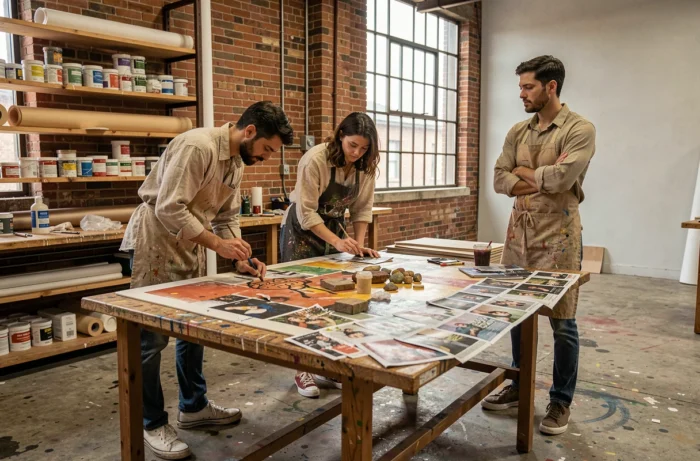
Alternative spaces and emerging contemporary art: a fragile economic model
Alternative spaces rarely operate on the classic model of a commercial gallery. Their economy relies on a heterogeneous mix: public subsidies, modest ticket sales, artist residencies funded by foundations, and sometimes ancillary activities (associative bar, space rental).
This structural fragility is not new, but it intensifies when institutional funding sources are reorganized. The case of Friche de la Belle de Mai in Marseille illustrates a hybrid model that has endured for several decades, combining artistic programming, social and solidarity economy, and strong territorial anchoring. Not all spaces have this foundation.
What distinguishes lasting spaces
Three factors emerge in field analyses:
- A real local anchoring, with partnerships established with non-cultural actors (social landlords, resident collectives, integration structures), which diversifies sources of legitimacy and funding.
- A clear programming that attracts an audience beyond the circle of insiders, without renouncing artistic risk-taking. Spaces that survive for a long time are those that manage to combine rigor and accessibility.
- The ability to document and showcase their activities to funders, which requires administrative skills often absent in informal collectives.
The most vulnerable spaces are those that combine geographical isolation and weak administrative structuring. The end of a single national interlocutor further complicates the situation for these structures.
Emerging artistic scene in France: fairs, galleries, and new pathways
The emerging art market is not limited to alternative spaces. Specialized fairs play a role as showcases and networking opportunities. Art-o-Rama, in Marseille, has established itself as a meeting point for emerging artists and multimedia practices. The recent edition highlighted what the organizers call “sentimental tuning,” focusing on the emotional and sensory dimensions of the work, breaking away from the strictly conceptual approach dominant in certain market segments.
In Paris, the landscape of contemporary art galleries continues to evolve. Several recent openings explicitly target the emerging scene and artists at the beginning of their careers, with varied economic models: some operate on a classic commission basis, while others rely on membership or participatory patronage.
The role of digital platforms in artists’ visibility
The visibility of an emerging artist today relies as much on Instagram or TikTok as on a physical exhibition. This reality alters the power dynamics: an artist can build an audience without going through the traditional filter of galleries or curators.
The available data do not allow for a conclusion that this digital visibility systematically translates into sales or institutional recognition. Online fame and artistic careers follow distinct logics, even if they increasingly intersect.
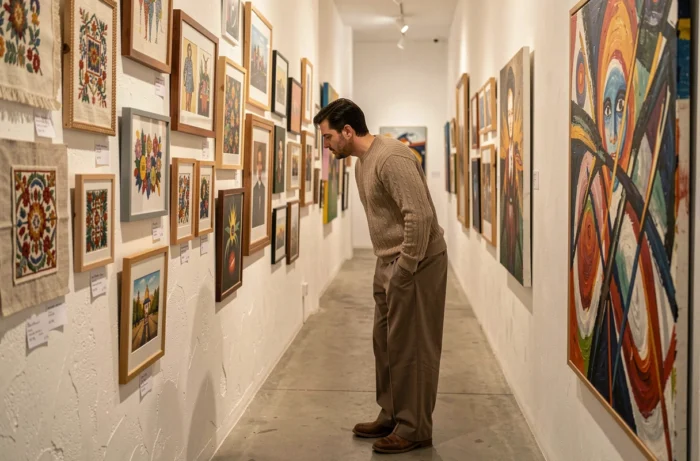
Alternative cultures: between institutionalization and resistance
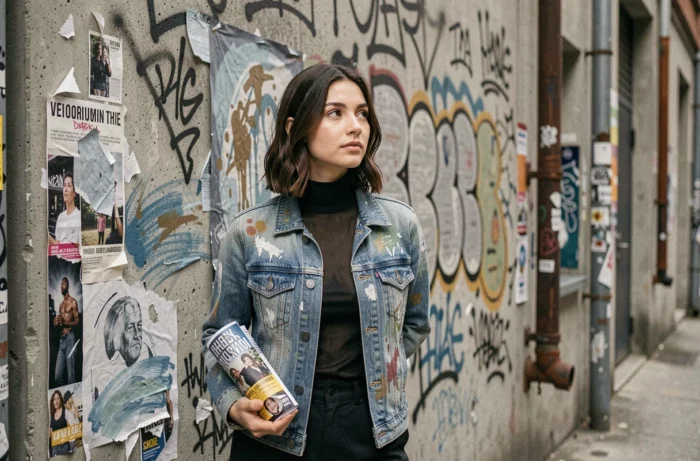
The term “alternative cultures” encompasses very different practices: urban art, experimental music, independent publishing, performances in public spaces, self-managed collectives. What connects them is less a common aesthetic than a positioning on the margins of dominant distribution circuits.
The recurring paradox of these scenes lies in their relationship with the institution. Does an alternative space that receives public funding remain alternative? The question does not have a clear answer, but it structures the internal debates of many collectives.
In Toulouse, a recent project associates the Secours populaire and local cultural actors in a third place with a solidarity and artistic vocation, further blurring the boundaries between social action and contemporary creation. This type of hybrid initiative is multiplying, driven more by social and solidarity economy logics than by the art market.
- Alternative cultures do not form a homogeneous block: they encompass very different practices, audiences, and economic models.
- Their sustainability depends less on artistic quality than on their ability to forge lasting local alliances.
- The disappearance of a national coordination framework (France Tiers-Lieux) accelerates a trend towards territorialization, with increasing disparities between metropolitan areas and less endowed regions.
Emerging contemporary art and alternative cultures are going through a period of recomposition. Support structures are changing, distribution channels are diversifying, and economic models remain precarious for a large part of the scene. What unfolds in the coming months, at the level of local authorities, will determine which spaces and which artists will find the conditions to continue their work.