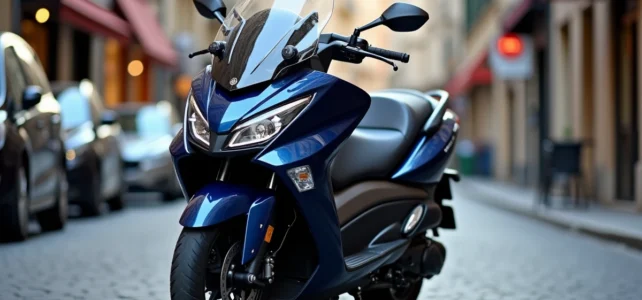
The Yamaha TMAX has dominated the maxi-scooter segment since its launch in 2001. While rumors of a 750cc engine fuel speculation, several regulatory and economic factors converge towards a likely price increase in 2026. What mechanisms are driving prices up, and to what extent will buyers pay the bill?
Price Evolution of the TMAX: Comparison Between Generations and Competing Segments
| Model | Engine Displacement | Transmission | Price Positioning |
|---|---|---|---|
| Yamaha TMAX 560 (2026) | 560 cm3 | CVT | High-end sport |
| Yamaha TMAX Tech MAX (2026) | 560 cm3 | CVT | Premium / touring |
| Honda X-ADV 750 | 750 cm3 | DCT | Versatile adventurer |
| TMAX 25th Anniversary (2026) | 560 cm3 | CVT | Limited collector’s edition |
The TMAX 560 is already sold in a segment where prices regularly exceed the symbolic threshold of 10,000 euros in the used market for recent models. The 25th anniversary edition, limited to one year of production, mechanically drives prices up by reducing supply.
The commercial proximity between the TMAX 560 CVT and the Honda X-ADV 750 DCT indicates that a shift to a larger displacement at Yamaha would result in a price repositioning aligned with Honda’s competition, or even above.
To learn everything about the price of the TMAX 750, it is necessary to cross-reference data from the new and used markets with the regulatory constraints affecting the segment.

Motorcycle Technical Control and Premium for Recent Models
The schedule for two-wheeler technical control directly impacts the valuation of maxi-scooters. Vehicles registered between January 1, 2020, and December 31, 2021, must undergo their first technical control within four months of their anniversary date, no later than December 31, 2026.
In contrast, models registered from January 1, 2022, will only be subject to this obligation starting in 2027, within six months preceding their fifth anniversary. This asymmetry creates a measurable market effect.
- Used buyers prefer recent TMAX models exempt from technical control until 2027, generating a price premium on the most recent vintages
- Models from 2020-2021 experience accelerated depreciation due to the cost and uncertainty of passing technical control
- A hypothetical TMAX 750 launched in 2026 would automatically benefit from this exemption window, enhancing its attractiveness and justifying a high launch price
Technical control is not just an administrative hurdle. It redistributes demand towards new or nearly new models, precisely the segment where a TMAX 750 would be positioned.
Low Emission Zones and Crit’Air Sticker: The Regulatory Filter Increasing New Prices
Traffic restrictions in ZFE-m (low emission mobility zones) add a layer of pressure on the thermal two-wheeler market. Maxi-scooters classified as Crit’Air 3 or higher face progressive bans in several French metropolitan areas.
A TMAX 750 homologated according to the latest anti-pollution standards would benefit from a favorable Crit’Air classification, ensuring access to all ZFE for several years. This regulatory passport represents a selling point that Yamaha can monetize in its catalog price. Older scooters, even well-maintained ones, lose value as soon as they can no longer circulate freely in dense urban areas.
Concrete Impact on the Pricing Grid
Yamaha does not need to justify a price increase solely by production costs. Regulatory compliance becomes a full-fledged pricing factor. A larger engine, combined with a recent anti-pollution standard and a temporary exemption from technical control, positions the TMAX 750 as a safe product for daily urban users.
Limited Edition 25th Anniversary and Scarcity Effect on the TMAX Market
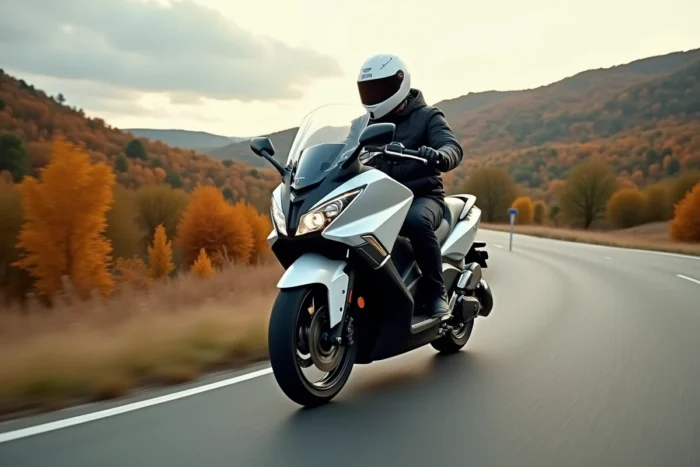
Yamaha has unveiled a special TMAX 25th anniversary edition for 2026. This model features a matte metallic gray color with a red seat with double stitching, available for only one year.
Limited editions in the maxi-scooter segment generate a dual pricing effect. First, they absorb some of the demand that would have shifted to the standard model, reducing the available stock in the used market in the short term. Secondly, their resale value remains stable or even increases, which pulls the entire range upwards.
The TMAX does not follow the classic depreciation curve of scooters. Some models over five years old show price surges on resale platforms. This phenomenon, unique to the TMAX, is explained by the loyalty of its community and calibrated production volumes. The arrival of a 750 version in this context would amplify this relative scarcity dynamic.
Raw Material Costs and Onboard Electronics: Price Pressure on Production
Transitioning from a 560cc engine to a 750cc one involves structural modifications to the engine, chassis, and transmission. Yamaha has gradually enriched the TMAX with onboard technologies: smartphone connectivity, multiple riding modes, TFT instrumentation. Each generation has added equipment without ever removing any.
A TMAX 750 would combine a larger engine block and a level of electronics at least equivalent to the current Tech MAX. The production costs of a larger displacement twin-cylinder engine, combined with electronic components (sensors, controllers, displays), leave no margin to maintain the price at the level of the 560.
The maxi-scooter market in France remains robust, but buyers face a convergence of upward factors. Regulation (motorcycle technical control, ZFE, Euro standards), the strategy of limited editions, and industrial costs all point in the same direction. For a TMAX 750, the question is not whether the price will increase, but by how much the gap will widen compared to the current 560.